South Park articles involving children
Is warning keeping kids out of 'Park'?
David Bauder, Associated Press writer
Photo by The Associated Press
The figure of Death chases, from left, Kenny, Cartman, Kyle and Stan in this scene from the popular "South Park" cartoon series on the Comedy Channel.
NEW YORK -- For years, tobacco companies insisted that they never marketed cigarettes to youngsters, even as smoking became increasingly "cool" and minors kept lighting up.
The booming popularity of Comedy Central's "South Park" presents an uncomfortable parallel for the television industry.
The animated comedy of racy third-graders comes with curses, bathroom jokes and Kenny, a character who meets a horrific demise every week. And Comedy Central's unprecedented ratings affirm its status as television's biggest new sensation short of "Ally McBeal."
But "South Park" wants only adult viewers. Doug Herzog, Comedy Central's top executive, makes that clear. It's the only series on television to carry a TV-MA rating.
Yet research shows that 20 percent of its viewers are 17 and under. So is there a better way for Comedy Central to keep youngsters from tuning in? Some school administrators and many parents are wondering whether more can be done.
In March, an elementary school principal in Canton, Ga., threatened to send children home if they wear clothes with "South Park" characters. Two principals in New Jersey wrote letters alerting parents to the show.
Kathi Rodger-Sachs, of the Henrietta Hawes School in Ridgewood, N.J., discovered first-grade pupils playing "Kill Kenny," with one child shouting a racial epithet. "Our children are very impressionable," the principal said. "If they see this as a norm, their behavior is going to reflect that."
Herzog admitted enduring a few sleepless nights before putting "South Park" on the air last August. Comedy Central's president and CEO knew that the series would push TV's barriers, but he called the show brilliant, and its humor not gratuitous.
So he scheduled it for 10 p.m. on Wednesday and agreed to the rating disclaimer "for mature audiences."
"We just want to say it as many times as we can If you're going to be offended, don't watch," he said, "and please, please, please pay attention to what your kids are watching."
That's not always so easy, said Denise Clapham, a mother of four from Brunswick, N.Y. Children watch television in their rooms, at friends' homes, with tapes easy to come by. "It's out there and they're going to see it, no matter what restrictions are put on it," she said.
Clapham's not thrilled that her 16-year-old son and his friends are "South Park" fans. "I think they can be funny without being that far out," she said, "and I'm liberal."
Yet trying to keep children away from a show like "South Park" runs counter to human nature and the lure of forbidden fruit, said Dan Anderson, a psychology professor who researches children's television at the University of Massachusetts.
In many respects, a TV-MA rating is a magnet. "Kids want to grow up," Anderson said. "They want to be older than they really are."
Comedy Central's Herzog is not sure what more to do, except maybe schedule the show for later. "But something tells me that (children would) still find a way to find it," he said.
The alternative -- taking "South Park" off the air -- raises even more disturbing questions about whether television has any room at all for such adult-oriented material.
On this issue, Comedy Central has an important ally. Kathryn Montgomery, whose Center for Media Education lobbied in Washington for television ratings, believes the cable channel has acted responsibly.
"You can't expect all of the programming on cable television and television in general to be appropriate for kids," Montgomery said. "What we do need to do is educate the parents."
No television executive likes criticism, but Herzog tries to see the New Jersey school principals as allies, not enemies. Anything that gets the word out that "South Park" is not for children is helpful, he said.
Herzog said Comedy Central has not licensed products specifically for children; there are no "South Park" lunch boxes and no "South Park" kids' clothing. He claims no youthful viewers when selling commercial time. And he believes any comparison to tobacco companies is ultimately unfair.
"There's no warning label on Comedy Central that says if you watch too much, it's going to cause cancer," he said. "I don't get to sell (to children), I'm not making money off them. Quite frankly, I wish they wouldn't watch it because it's a bit of a hassle.
"Go to bed!"
Elsewhere in television ...
SOUTH PARK ON DISC If the show's not enough, American Recordings has just signed a contract to produce a series of "South Park" soundtrack discs. Company president Rick Rubin, a leading rap entrepreneur in the 1980s, will put them together. He'll work closely with Trey Parker and Matt Stone, co-creators of the series, to "capture the transgressive wit and rebellious energy of the show." No word yet on whether the disc will get a parental warning label.
Comedy Central hit cartoon 'South Park' is smarter than it looks (12/16/1997)
Comedy Central hit cartoon 'South Park' is smarter than it looks out as you can but then keep it totally grounded in this reality," says Parker. For its growing army of fanatic young fans, "South Park" has become a welcome refuge from the sensitivity police. "In an age of political correctness, it's like a relaxation of these restrictions. It's a release," says Liebling. There's a vicarious thrill to going to a world that's seemingly forbidden.
And these (cartoon) children make it less threatening." It's not surprising then that tubby, foul-mouthed Cartman, who consumes massive quantities of his favorite snack food, Cheesy Poofs, has become the show's breakout kid. "He's so fun to do, so fun to write," says Stoie. "He's a selfish little bastard. There's no character like him anywhere." It's simple, concludes Stone. He and partner Parker are free to be as wild and crazy as possible because "people want 'South Park' to blow their mind." Comedy Central isn't complaining.
The Spirit of Christmas," which has never aired on TV, is the highlight'of "The 5th Annual Spike and Mike's Sick and Twisted Festival of Animation," debuting at the Magic Bag in Ferndale Wednesday night And "South Park" has recently been sold internationally by Comedy Central to Canada, England, Australia, Brazil and other Latin American countries. That's right, a foreign exchange program for South Park Elementary School students Stan, Kyle, Kenny and Cartman. So now the whole world will discover the wonder of Cheesy Poofs! "I never watched TV growing upr says Stone. "I think TV is pretty lame. The only things I watch now art Jerry Springer and football." Well, OK, Jerry Springer, football and "South Park." Cool.
Totally awesome. Right, Cartman? Hey, quit bakin' those brownies! TV critic Mike Duffy can be reached at 1-313-222-6520. Or send E-mail to The show's ratings have been soaring upward, reaching an astonishing 4.8 for the Thanksgiving special. Astonishing because, as a cable network, Comedy Central averages just a 0.6 in prime time. (A rating point for Comedy Central represents 460,000 TV households.) And prior to the arrival of "South Park," the network's highest rating was a 2.7, for the second season premiere of "Absolutely Fabulous." Better yet, says Liebling, more and more people are just beginning to discover "South Park." Even the frequent reruns are doing big numbers.
"There's a lot of fuel left in this rocket" she says. Comedy Central will follow up the opening season of 13 episodes with 20 new episodes in 1998 that will start airing in May. Meanwhile, "South Park" T-shirts and other trinkets are becoming a merchandising mother lode. College students are tossing "South Park" parties. The infamous "South Park" pilot, Stone and Parker for their "unique comic vision." The witty, well-crafted storytelling on "South Park" is sharply satiric and knowing.
Everyone from Patrick Duffy to Sally Struthers to Kathie Lee Gifford has been gunned down in the show's celebrity culture shooting gallery. To Parker and Stone, who write each episode and do voices for all the key characters except Chef, nothing is sacred. Heck, George Clooney did a barking celebrity cameo as the voice of a gay dog named Sparky. "We make fun of everyone and everything," says Stone, who along with Parker has put every topic from euthanasia to homophobia under the rambunctiously acerbic "South Park" microscope of amusement On a food-crazed Thanksgiving episode, the show explored modern American gluttony. Through fickle cartoon fate, Cartman and his pals wound up "adopting" a young Ethiopian famine victim named Starvin' Marvin.
The challenge is to go as far South from Page ID things," says Stone from the "South Park" production offices in Los Angeles. "It's not as watered down as regular TV comedy. We do whatever we think is funny." On Wednesday night's debut of the heavily anticipated "South Park" Christmas special, the musically punctuated story revolves around how Kyle is feeling left out because he's Jewish. Liebling has labeled the episode "adorably offensive." With its different demented strokes for different chucklehead folks, "South Park" is unlike anything else on TV right now. Shrewdly, Comedy Central has dodged any "Beavis and parental backlash or political controversy by airing the series only after 10 p.m.
And the show is labeled TV-MA (for Mature), which signals parents the show is aimed at adults. Though initially pigeonholed as a "potty-mouthed Peanuts" by some critics, including this happily addled sofa spud, the show imaginatively manages a precarious funnybone bal ance. "You can be mean and stupid and still intelligent 'South Park' is like that," says Jim Olenski, co-owner of Thomas Video in Clawson and a devoted observer of pop culture. Yes, sophomoric and yet sophisticated. "The truth is," says Stone, "it's just as hard to be sophomoric and funny as it is to be sophisticated and ftinny.
There are 40 different ways to do fart jokes." Oh joy, the topic of broken wind. It is a favorite obsession of the round-faced 8-year-olds on "South Park." They have numerous cuckoo code words for flatulence, like "baking brownies." But these kids are all right. They're doing a lot more than cutting cartoon cheese and jabbering profane variations on names for their assorted body parts. Particularly the posterior. "If it was just some naughty words, it wouldn't be funny.
SOUTH PARK' WARNING TREND: 2D N.J. SCHOOL ALERTS PARENTS (March 19, 1998)
ANOTHER New Jersey principal has come out swinging against Comedy Central’s animated series “South Park.”
The top administrator at the Henrietta Hawes grammar school in Ridgewood has become the latest principal to send notes to parents of grammar-school kids alerting them to the foul-mouthed and sometimes racially charged content of the show, which airs Wednedsays and Saturdays at 10 pm.
- The show carries the TV-MA label the strongest available, meant to warn off viewers younger than 17.
- “We had an incident, where the kids were playing ‘South Park’ games,” said Henrietta Hawes Principal Kathi Rodger-Sachs. “In the program they always kill Kenny, and they were killing Kenny.”
Rodger-Sachs admits she doesn’t have cable, but after the incident she had a teacher tape “South Park,” which was then shown during a staff meeting. “We played two minutes,” she said. “I was absolutely shocked.”
Her notice to parents comes just days after a similar letter from a principal in Point Pleasant, N.J.
“It’s a show that is not meant for children,” said a Comedy Central spokeswoman. “That’s why it’s rated TV-MA, and that’s why it airs at 10.
In her letter, Rodger-Sachs said the show “might look innocuous at a glance, but the content contains inappropriate language and racial slurs.”
Rodger-Sachs also expressed concern about young students staying up late to watch.
She told The News that she has to tread lightly with her warning. “I leave it up to parential discretion,” she said. “There’s only so much we can do.“
TO SCHOOLS, `PARK' ISN'T KIDS' STUFF
Surely the obnoxious, round-faced boys from "South Park" would have something to say about Principal Kevin O'Connor's decision to ban the cartoon's T-shirts and images in his Cary school.
The problem is, the hip yet foulmouthed boys' retort probably would be unprintable.
And therein lies the problem that O'Connor and school officials nationwide are facing: The cute cartoon show may be irresistible to kids, but it has a richly deserved mature-audience-only rating and is Exhibit A in the case for the V-chip.
Since its August debut, the series about four scatologically minded prepubescent hellions has pulled in high ratings for the cable-TV network Comedy Central. Despite airing the program at 9 p.m. and labeling it with a warning to parents, "South Park's" producers acknowledge that about 20 percent of the show's viewers are 17 and younger.
In recent months, school districts across the country have issued warnings to parents, banned the wearing of "South Park" clothing and complained about students mimicking the cartoon stars' penchant for cursing, flatulence and all-around bad-boy behavior.
"Because it's done in a cartoon fashion, parents may feel it's designed for children," said Cary District 26 Supt. Timothy Kelly. "If no one's monitoring, they come away with perceptions that shape the way they behave."
The reaction mirrors the response that many schools had to Bart Simpson and Beavis and Butt-head, TV cartoon creations that once seemed on the edge with their language and behavior but now have seeped into the public mainstream.
Still, critics of "South Park" say the show's characters go where even Bart, Beavis and Butt-head didn't. Besides the bathroom humor, the show flirts with racial stereotypes, and some shows have featured questionable sketches about Jews and homosexuals.
The show's characters include Cartman, whose idea of a fun Halloween involves dressing like Adolf Hitler; Stan, who throws up whenever his puppy-love girlfriend approaches; and Kenny, who is killed off in gruesome fashion in each episode, only to be resurrected the following week.
Last month, a teacher at Maplewood Elementary School in Cary discovered that some of her 4th graders had published a little "South Park" newspaper with drawings of the show's characters. Copies sold for a dime.
"One of the teachers said she admired the kids as entrepreneurs in selling it," said O'Connor, the principal. But he added, "When we got into the content of it, we got a little more concerned."
Suspended in bubbles above the crayon drawings were bold expletives. So O'Connor sent a letter to Maplewood parents, reminding them that "South Park" is an adult show. And he ordered kids wearing "South Park" T-shirts, some adorned with obscenities, to turn them inside out while on school grounds.
"I am concerned that the influence of what I would consider inappropriate content of `South Park' is working its way into our school," O'Connor wrote to parents.
Unlike "South Park's" irreverent brood, principals and teachers have been politely respectful of the show's creative liberty and careful not to criticize adults who tune in.
But they have expressed concern about children who are watching and bringing "South Park's" characters and story lines with them to school.
The principal of Hickory Flat Elementary School in Cherokee County, Ga., touched off a firestorm when she banned "South Park" clothes and sent a letter to parents warning them that some youngsters were watching the show.
Some schools have been warned not to take the fight against "South Park" too far. In Cromwell, Conn., the school board considered a districtwide ban of "South Park" T-shirts but backed off in February on the advice of its lawyer.
Complaints from teenage students and civil liberties activists poured in, contending that school officials were threatening the students' freedom of expression. In the end, the school board decided to ban the wearing of only two "South Park" T-shirts that contain obscenities.
"The message of the show was running counter to what we promote," said Cromwell Schools Supt. James Gere. "There are a lot of put-downs, poking fun at people's differences, that type of thing. I only watched it a couple of times, but personally I was turned off from it."
Tony Fox, a Comedy Central spokesman, said the boys' behavior is not offered up for emulation. It is satire, he said.
Even children's television activists agree that "South Park" promoters have taken necessary steps to get their "adults only" message out. In addition to its late-night spot and strong viewer warnings, licensed "South Park" T-shirts are made only in large or extra-large sizes and are not sold in children's stores, Fox said.
"We don't have a problem with schools letting parents know that this is an adult show. That is exactly what we've been doing since it started," Fox said. "The good thing that may come out of this is parents may be more diligent about what their kids are watching at night."
And seldom mentioned are the moments in the show, however few, when a thread of sweetness and decency emerges. The Christmas special offered a shining moment of redemption. The show's creators spared Kenny's life--for one week at least.
THE DEMENTED MINDS BEHIND `SOUTH PARK (April 3, 1998)
Things we found out in sessions featuring Matt Stone and Trey Parker, the creators of Comedy Central’s profound, profane animated hit series “South Park” (at 9 p.m. Wednesdays), while here for the U.S. Comedy Arts Festival:
– When the two approached soul sensation Isaac Hayes about voicing the role of Chef, the cook at foul-mouthed 3rd graders’ Kyle, Stan, Kenny and Cartman’s elementary school, Parker said to him, ” `Isaac, you’re this big fat black guy, and you’re the only black guy in town, and because you’re black, you sing all the sexual songs.’ Isaac said, `Okay.’ “
– The boys have a philosophy on charges that “South Park” is the wrong influence for children (they have repeatedly said the show is for mature audiences): “I think there’s a lot worse stuff they are watching,” said Parker, 28. “If I had kids, I’d rather they be watching `South Park’ than `Full House’ . . . you want your kids to grow up with a brain.”
– In a very early version of “The Spirit of Christmas,” the short animated video that launched Parker and Stone’s career, the character of “big-boned” Cartman was originally Kenny, the kid who dies in every episode; in this version, he dies at the tentacles of a mutant Frosty the Snowman.
– Stone, 26, considers Cartman the “most fun” character on the series (Cartman “has become such a force of nature,” he said). Parker added that no one has to worry about the two running out of ideas, because they could just focus on Cartman, who “we’d need 20 years to explain.”
– Plans in various stages of development: a “South Park” feature-length movie; an album with Chef singing duets with big-name recording stars like Ozzy Osborne and Fiona Apple; and a home video game from Acclaim Entertainment. The first six episodes of the series are expected to be available on video in May.
– The two gave major props to “The Simpsons,” which Parker said is “way better than our show . . . we obviously couldn’t have done this four years ago . . . they opened the door for us.”
– Parker and Stone did a viciously funny Barbra Streisand episode (their favorite), in which the superstar turned into a rampaging, Godzilla-like killer monster — but still had time to sign autographs. The two still haven’t forgiven Streisand for her strong support of boycotting their native Colorado a few years ago because the state approved an anti-gay rights amendment
Streisand recently said she thought the episode was funny, but Stone thought she had to say that “or else she’d look like a (witch).”
– The boys originally pitched Mr. Hankey, the Christmas Poo — the miraculous, toilet-bowl-dwelling holiday elf — to Comedy Central as a series before the idea for “South Park.” Parker said that when deciding which network to work with, they went with Comedy Central because when he asked, “How do you feel about talking poo?” a C.C. executive exclaimed, “Love it!”
They’ll stay with Comedy Central because, according to Parker, “we knew we could make the show we wanted to make. The reason the show works is because we don’t follow any rules.”
– The two originally didn’t think much of the Christmas and Thanksgiving episodes, which feature Mr. Hankey and Starvin’ Marvin the Ethiopian boy, respectively. Arguably the episodes are among the best in the series, but “our favorite episodes are exactly everyone’s least favorite,” Stone said.
– The guys promise Mr. Hankey will make another appearance. Howdy ho!
The identity of Cartman’s father was finally revealed this past Wednesday in the episode cryptically entitled, “Cartman Finds Out the Identity of His Dad.” Relive the beautiful moment at 9 p.m. Saturday on Comedy Central. New episodes of the series begin May 20.
Talk that talk
Adele Givens has returned to her hometown in a new forum. She’s starring in “Talk Show Live!” a new stage play co-produced by Yvette Lee Bowser, the creator of Fox’s “Living Single,” and the creator and producer of the new NBC Tuesday night comedy “For Your Love.”
Givens, a sassy and incisive comedian who gained fame for her raunchy appearances on HBO’s “Def Comedy Jam,” essays the role of Aunt Tee in the stage production. It’s a takeoff on the popularity of racy, raucous daytime talk shows, which, thanks to Jerry Springer’s slug-fests masquerading as talk, have gained a special notoriety in the last few months.
Also appearing in “Talk Show Live!” is Arthel Neville, former host of “The Arthel & Fred Show” and “Extra.” The show runs through Sunday at the Arie Crown Theater. Tickets are available at the box office or by phone, at 312-559-1212.
Tip the hat
Let’s give a hearty congratulations to Mike Siegel, a former Chicago standup comedian who won a six-figure sitcom development deal by NBC.
Siegel, a very witty guy, has plied his comedy trade for the last seven years and was a welcome addition to the local ranks when he performed at such clubs as the Improv and the Funny Firm.
The comic will meet with writers to either create his own sitcom, or appear in a pilot that could lead to a series.
Siegel, who caught the eye of network executives while doing some good work at last year’s Montreal International Comedy Festival, has spent recent years as a video DJ for VH1.
Due South of Funny for Kids (May 3, 1998)
All educators must encourage children to spend less time in front of a TV screen. By limiting quantity, the quality, or content, of the viewing experience is automatically addressed. Obviously, the less viewing time, the less chance there is of something offensive being seen by a child. However, in choosing to directly address the issue of quality, censorship comes into play. And for educators, censorship is a sensitive issue.
In general, the censor’s role in regard to television is something that can only be taken on by a parent, at home. Recently, however, an issue has arisen in which it is appropriate for educators to concern themselves with content. That issue is “South Park,” which Time magazine calls “an imaginative recreation of authentic experience” and goes on to refer to its “vibrant vulgarity.”
I guess I’m somewhat out of touch, perhaps not sophisticated enough to understand the concept of vibrant vulgarity. I’ve always looked upon cartoons as an innocent venue, child-friendly, a seductive medium for kids. However, there’s nothing innocent or child-friendly about foul-mouthed third-graders routinely harassing their disturbed teacher, who often addresses the class through his hand puppet; or Cartman, a student bigot; or Mrs. Cartman, his mother, whom the children refer to as a crack whore and a dirty slut; or Uncle Jimbo, a trigger-happy gun fanatic; or Mr. Hankey, a talking piece of feces; or Kenny, a destitute kid who dies horribly in every episode, etc., etc. . . .
I think about children, and I am offended that the show’s creators would even consider a school as a setting. I think about teachers, hard-working professionals doing one of the most demanding jobs in the world, and I am hurt that the profession is subjected to such ridicule. I think about parents--supportive, active, involved, nurturing--and I can’t even imagine the thought processes that would go into portraying the show’s parents in such dishonorable, disrespectful and amoral terms.
One hopes against hope that this is not the direction media are moving toward in the name of ratings. However, when I hear that the next season’s 20 episodes are ready to roll, and that there’s talk of a feature movie, and that there’s been $30 million in T-shirt sales, and that more than 250 unofficial web sites have sprung up, and that a sound-track album is being produced, and that according to Time, even though the show is particularly strong among 18- to 24-year-olds, an estimated 5% of the viewing audience is younger than 11(I suspect it’s much more), then that direction is becoming clearer.
It is in Los Angeles, specifically the Hollywood-San Fernando Valley area, that real change can occur in regard to the type of television shows children will watch. Where else can high-level media decision-makers directly interact with the community they are trying to reach? That interaction should include authentic dialogue and feedback from parents and teachers regarding media messages that are impacting children. What better way to ensure responsible, child-appropriate programming?
Hopefully someone, somewhere will make an honest effort to jump-start this communications process. Until then, as educators, all we can do is strive to create school atmospheres that are in touch with the world outside our doors yet at the same time reflect a collective spirit of childhood innocence. Anything that may impact negatively on that process, such as a show like “South Park,” is something all parents should be aware of.
Move Over Beavis, Meet Kenny (June 6, 1998)
The cable TV cartoon “South Park” has been called “Exhibit A in the case for the V-chip.” The popular show, which has been drawing audiences in excess of 6 million viewers, goes where even “Beavis and Butt-head” dared not to tread. One character, Kenny, dies each week in a different way. Besides bathroom humor, the shows flirts with racial stereotypes and has featured episodes about Jews and homosexuals that have raised issues of taste. The producers acknowledge that about 20% of the show’s viewers are 17 or younger. The show has spawned a line of T-shirts and clothing that has been banned by some schools around the country.
KATHRYN McLAREN spoke to young viewers about the show’s appeal.
*
HEATHER McCOY
19, sophomore, Cal State Northridge
I watch this show to have fun and escape from taking things so seriously. I gather weekly at the student union with at least six or seven other students to watch. Some of the things they do are just unbelievable. In one episode, they had Jesus boxing Satan. They went way out of bounds with that. It was sacrilegious.
But in another episode, they taught a good lesson. The little boy’s dog was gay and the boy was whining that he wanted a straight dog. The lesson was that the boy should appreciate his dog the way it was.
This kind of humor is OK because it makes fun of everyone, even if I find some of the things they say distasteful. Fraternities and sororities have viewing parties. Wednesday night is “South Park” night. My parents don’t watch it, but I hear adults at work talk about it being funny. I think it’s just something new, the new craze, like the early Simpsons.
I work at a store and we sold a lot of “South Park” stuff at Christmas. “South Park” items are very hot, especially a shirt depicting six times Kenny has been killed. Most of the buyers are between 10 and 20-something; more are male than female, yet I see all age groups purchasing these items.
*
ZICHRI VASQUEZ
20, retail clerk, Pasadena Plaza
I watch “South Park” because it’s funny, especially how they talk. I think that it’s not true to life and if kids came to where I work and talked like that, I would be offended. I also watch “Beavis and Butt-head,” but I prefer “South Park” because it’s so different and original. I find nothing offensive or gross about it. My favorite killing of Kenny is when he got microwaved and then eaten by the mice. You can’t take it seriously.
I don’t know any adults who watch it. My parents know I watch it, but I don’t think they realize what it’s like. I work in a mall, and I don’t see people wearing “South Park” clothes. Young kids should not be watching this show. Parents should monitor what they are watching.
*
JOSH NOLTE
17, senior, Antelope Valley High School
South Park” is something I do late at night when I have nothing else going on, which is about twice a month. I don’t drop everything just to watch it. I enjoy the animation and like how artificial the characters look and speak. I appreciate it from an artist’s point of view.
It goes way beyond other cartoons, including “Beavis and Butt-head.” I don’t know any adults who watch it, but I think everyone would find it funny. I think it’s appropriate for young kids.
The killing of Kenny is something I look forward to. The moms are like little hick moms who don’t know nothing about anything going on, yet they fit the stereotype of a lot of parents. The best Kenny killing was the Christmas episode when they didn’t actually kill him and he was cheering about that. The killings don’t bother me because I know it’s just a cartoon. I thought the episode where Mr. Hankey was jumping around and leaving little poops all over everywhere was gross. The stupidity goes a bit overboard.
I especially like when they pick a famous person or celebrity to poke fun at. I don’t own any “South Park” shirts or hats, but I think that it violates kids’ civil rights to have these clothes banned from their schools. If my younger sister watched “South Park” and starting acting and speaking like they do on the show, I wouldn’t let her watch it anymore.
*
RUBIN MORENO
17, sophomore, Garfield High
South Park” is stupid and funny at the same time. I don’t find it offensive or gross like some people do. I live in the inner city and I haven’t heard anything on the show that I don’t hear on the streets. Young kids really act and talk just like on “South Park.” Other cartoons are just as violent. They have killings, beatings, explosions and run over all kinds of things that little kids see.
I drop everything and make a point to watch it. I just sit back and trip out. I don’t think they should ban kids from wearing “South Park” attire. I haven’t bought anything from the show, but I’m waiting for the action figures to come out. I don’t know any adults who watch it regularly, but my parents know I watch it and they have seen parts when I’m watching it.
TV SHOW CALLED `APPALLING’
With its foul- mouthed cartoon third-graders, the popular animated television show “South Park” has been described as “Peanuts gone terribly wrong.”
Cromwell school officials call it “appalling.”
To curb the show’s widespread influence, the school board is considering banning clothing with “South Park” characters from all of the district’s schools. Administrators say the show, under the guise of humor, sends the wrong message to students with its racist and scatological remarks and graphic violence.
“We’re trying very hard here not to let students wear things that are disruptive to the educational give- and-take,” said middle school Principal Harry Dumeer. “I’m concerned the shirts are going to become more popular with the kids. I have the feeling some parents are purchasing these shirts in all innocence.”
Cromwell would appear to be the first school district in the state and may be among the first in the nation to consider such a move. And it’s already garnering criticism from students, Comedy Central (the cable television channel that broadcasts South Park) and civil liberties activists.
“I put this subject in the category of adult hysteria, to prove that adults can be as childish as children can be,” said Joseph Grabarz, executive director of the Connecticut Civil Liberties Union.
He said banning the “South Park” items, which are mostly T- shirts and baseball caps, would abridge freedom of expression by giving school officials authority to deprive a student of education for violating the ban.
“I’ve got a question for these people,” he said. “Would they ban a T- shirt with a man crucified on a cross, with nails in his hands and feet? And what if that man was Jesus Christ? That image is a very violent image as well.”
But school officials say the shirts are tied to a show where derogatory comments are made about ethnic groups, homosexuals and Jews, and where one character, Kenny, is violently killed in every episode.
One middle school student has already come to classes wearing a T- shirt saying, “Oh God, they killed Kenny again,” school officials said.
Kenny is one of the four simply drawn, almost cute-looking characters in “South Park,” a fictional Colorado town created by Trey Parker and Matt Stone. The show debuted in August, quickly becoming popular in its 10 p.m. Wednesday slot. It is rated TV-MA, meaning the show has content for mature audiences.
The Cromwell school board almost banned the shirts at its meeting Tuesday, but decided to check with an attorney first. Once banned, the shirts and caps would join baggy jeans, sexually provocative clothing and gang-related items on the district’s list of inappropriate school attire.
Dumeer said the district is trying to be specific about wording the ban so that officials aren’t telling students how to dress.
But some Cromwell students, as well as a spokesman for Comedy Central, said a ban would be unwarranted censorship.
“It is weird, because we’re being taught about freedom of speech, but we can’t practice it,” said Cromwell High School junior Roslyn Selsky, 17, a student representative to the school board. “I mean, ‘Beavis and Butt-head’ is much more lewd and obscene than ‘South Park.’ “
“South Park” fan Brad Parsons, 16, said students know the show’s remarks — referred to as “no brow humor” on the cover of Rolling Stone magazine — are not politically correct. “We understand we shouldn’t go out and imitate the show,” he said.
Stores such as Filene’s carry the “South Park” T-shirts, most of them not as graphic as the Kenny shirt. They retail for about $18.
Tony Fox, Comedy Central’s senior vice president of corporate communications, said Cromwell is the first district he knows of that is considering a ban.
“My initial reaction was going to be, ‘Are they going to hold a book burning, too?’ ” he said. “We have always contended ‘South Park’ is an adult show. It’s contingent on parents’ exercising discretion.”
He said the show “pushes the envelope of what people are used to seeing on television,” and he doesn’t let his oldest child, who is 6, watch it.
But that doesn’t mean he approves of the ban.
“I have three young kids and I would have a hard time dealing with a school district telling my kids what they can or cannot wear to school,” he said. “While we don’t recommend children under 18 watch the show, I would argue a kid 14, 15, 16 years old is smart enough to understand the show. Quite honestly, it’s a comedy show. We’re trying to make people laugh.”
A 12-year-old boy left a suicide note telling his parents to watch the cartoon show "South Park" to learn why he killed himself.
The note mentioned the character Kenny, a silent third-grader who is killed violently in every episode of the popular show, which appears on the Comedy Central cable channel.Maryland State Police said the note mentioned South Park but refused Friday to release a copy. The boy, Darron Lawrence Green, was found with a plastic bag over his head, sealed around his neck with masking tape and a tightened drawstring cord, police said.
The boy showed no signs of depression before killing himself May 14 and he had a loving relationship with his parents, Worcester County investigator Mike McDermott said.
Rated ‘R’--as in Ridicule (6/28/99)
The plot of the new “South Park” movie seems torn from today’s headlines: Young kids sneak into an R-rated movie and become so entranced by the four-letter words they hear on screen that they can’t stop using them. Their parents and eventually the government are so outraged that they take drastic action--everything from implanting a V-chip in a child to declaring war.
It’s an exaggeration of recent events, of course, but clearly the R-rated “South Park: Bigger, Longer and Uncut” is a case of art imitating--or at least satirizing--life in ways that have already brought controversy to the raunchy comedy based on the popular Comedy Central TV series.
The animated musical, which opens Wednesday, makes the Motion Picture Assn. of America’s rating system an object of ridicule. The “South Park” kids make repeated and vivid use of explicit language--in fact several of its songs are built around words not uttered in polite society. But that’s relatively mild compared to the feelings “South Park’s” creators, Trey Parker and Matt Stone, have toward the MPAA.
“They [the MPAA] have no set rules. Things change from movie to movie,” says Stone. “It makes no sense. . . . In going through their notes we saw that they had no standards so we decided these people are stupid and we’d just try to get it past them. If there was something they said couldn’t stay in the movie, we’d make it 10 times worse and five times as long. And they’d come back and say, ‘OK, that’s better.’ ”
Stone believes the MPAA was more lenient toward “South Park” because of pressure applied by Paramount, which is releasing it. Both the studio and the MPAA vehemently deny that assertion.
MPAA head Jack Valenti labels Stone’s comments “an obscene lie. I don’t allow member companies to lean on the rating system.”
“South Park” arrives at a worrisome time for Hollywood, when Washington’s latest finger-pointing at the industry for depictions of violence and sex, and marketing adult films to teens is at its peak. An understandably nervous Paramount finds its film being an involuntary test-case for theater owners’ recent voluntary pledge to ask for photo identification when selling tickets to R-rated films. In the next few weeks, two R-rated movies with sexual content, the teen comedy “American Pie” and Stanley Kubrick’s “Eyes Wide Shut,” will open, bringing further scrutiny to the theater owners’ new policing policy.
Despite its cast of 8-year-old characters, “South Park” is “most definitely a film for adults,” says Paul Dergarabedian, head of Exhibitor Relations, an industry tracking firm. “But it had strong kid appeal. The whole ID idea is a new thing and it’s going to have the inevitable growing pains. Kids will slip through the cracks.”
“Exhibitors must be in a quandary,” says one competing studio executive. “I wouldn’t want to be the poor theater manager after some parents come out of the screening.”
The self-referential plot of “South Park” directly confronts these questions. For example, after sneaking into the R movie, the South Park brigade wears T-shirts from the offensive movie in class--a sly reference to real complaints stemming from kids wearing “South Park” T-shirts to school.
Outraged parents take matters into their own hands, which escalates to a declaration of war on Canada, where the R-rated film-within-the-film was produced. Although it seems incredibly up to date--including references to the Jar Jar Binks character from the new “Star Wars” film--Parker and Stone say they decided on this plot for the movie well over a year ago.
“We know intimately what some of the reactions to ‘South Park’ [the TV show] have been,” says Stone. “We decided that if we were going to skewer zealots and moral watchdogs, we didn’t want to be self-righteous, so we took a few jabs at ourselves.”
The R rating for the film calls into question the MPAA’s criteria--which again was intentional. Besides the film’s widespread use of curse words, it contains something to offend nearly everyone, including crude treatment of celebrities ranging from Bill Gates to the Baldwin brothers. Having insisted on an R rating in their contract with Paramount (which originally asked for a PG-13 movie), Parker and Stone left it to the studio to deal with the MPAA.
“We got an R because Paramount was behind it,” says Parker. “But the independent filmmaker gets screwed.”
“That’s not true,” counters Paramount senior executive Rob Friedman, who was involved in the ratings arbitration process with the MPAA. “Anybody who submits their movies for a rating, whether they’re an independent or a studio, falls under the same guidelines.”
An obviously outraged Valenti of the MPAA noted: “We’ve been in business for 30 years and while there have been occasional errors in judgment, there has never been any evidence of malfeasance or bending to pressure. The ratings board is immune from that pressure. If they have some evidence of this, I’ll fire whoever’s responsible.”
Parker and Stone have crossed swords with the ratings organization before, losing their battle on the independently made film “Orgazmo,” which received an NC-17 rating, they say, despite the fact that they consider it to be mild by comparison to “South Park.” “The reason we got the NC-17 on ‘Orgazmo’ was that it was released by October Films, which had no clout, and we didn’t have the money to reedit the film and continue to resubmit it,” says Parker.
“It’s all politics, relationships at the top,” says Stone. “It’s who you know. If you’re Steven Spielberg and you want to push those limits, like in ‘Saving Private Ryan,’ you can because it’s done in the name of high art and how much money he makes [for the industry].”
The satirical skewering in the film obliterates any line of political correctness. Though the $20-million film began production several months ago, changes and inserts were made until a week ago. The script for the 83-minute film went through about 40 drafts.
“Paramount was freaking out because we were adding things a week ago,” says Parker. “We don’t finish the TV shows sometimes until a day before they air.”
Since the film takes several racial, ethnic and gender swipes, Parker and Stone couldn’t resist what they saw as the racist implications of “Phantom Menace’s” Jar Jar Binks character. “We just had to one-up George Lucas,” Parker laughs. At the same time, Stone says they were nervous about the satirical use of blacks as human shields in the film’s war sequences, in light of the real use of citizens as human shields in the recent Kosovo conflict. But they decided not to censor themselves.
“If it exists, we make fun of it,” says Stone. Adds Parker: “There isn’t a place we won’t go. As soon as you say we can’t make fun of this, we know we have to. . . . Society needs to realize it’s comedy. Laughing at something doesn’t mean we don’t care about it. A racist joke is not an endorsement of racism.”
As fans of the TV series are aware, real-life celebrities are often the target of Parker’s and Stone’s pillorying, and the credits of the film mention that the famous people are depicted without their permission. However, there are certain legal guidelines set forth by the lawyers at Paramount and Comedy Central, says Parker. For example, one of the biggest laughs in the film comes when Microsoft’s Bill Gates gets shot--a scene which was legally approved. “You can kill him. But you can’t say that Bill Gates must die,” Parker explains.
Even fans of the Comedy Central series, which just began a new season two weeks ago, may not be prepared for some of the film’s more scabrous elements, especially in light of the magnifying glass the entertainment industry is under in regard to content.
“We’ve only seen it with one audience, at the premiere [last week],” says Stone. “Some people were offended. But I don’t think the 70% or 80% who loved it would have loved it as much if the 20% weren’t pissed off.”
Parker and Stone say they’ll react to any outcry against the movie in the same way they reacted to initial protests against the TV show. “We’ll do now what we did then: ignore it and do our work,” says Parker. “Let Paramount deal with it.”
Friedman asserts that Paramount has done its job in laying the groundwork for parents to make a sound assessment. “We clearly state that the film is R-rated in all our materials,” says Friedman. “It’s a widely watched TV show, predominantly by adults. I believe anyone who is aware of ‘South Park’ knows that it’s sophisticated humor. We’ve gone out of our way to stress that.”
The filmmakers doubt that the theater owners’ new enforcement policies will prevent determined kids from getting in to see the movie--much as the “South Park” kids do in their own movie, thanks to a homeless man who buys them tickets. “I think ‘Wild Wild West’ [which is rated PG-13] is going to sell a lot of tickets next week,” Parker says with a laugh.
“I remember being 13 or 14 and buying tickets to one movie and sneaking into a ‘Monty Python’ film or ‘Stripes.’ But they didn’t make me want to go out and kill people. There are worse things for kids to see.”
Not that Parker disagrees with the rating. “The R rating is perfect. Kids shouldn’t see this on their own. If their parents think it’s OK to take them, that’s their decision.”
NETWORKS ARE SEEING BLUE WHEN IT COMES TO PROFANITY (February 7, 1998)
Remember how comedian George Carlin used to yuk it up about the seven profane words you can’t say on television?
Well, that was back in the early 1970s. Unfortunately, it won’t be long before his entire list is put through the shredder.
That’s because the language on prime-time TV has made a steady trickle toward the gutter and shows no sign of reversing its course. These days, in addition to scenes of violence and partial nudity, viewers are hearing words that would have been unthinkable only a decade ago.
“I can’t tell you how angry the language issue makes me,” says Lauryn Axelrod, a longtime media analyst, teacher and author of the book “TV-Proof Your Kids” (Citadel Press, $12). “Twenty years ago you wouldn’t have even heard the word `butt’ on TV. It just wasn’t acceptable. Now they let fly with just about anything.”
Especially on cable. Since its early days, cable TV was a place viewers could get unedited versions of theatrical feature films. But then cable execs began allowing even original programming to pretty much enjoy free rein.
HBO’s critically acclaimed sitcom “The Larry Sanders Show” and groundbreaking prison drama “Oz,” routinely make a mockery of Carlin’s list. In the fall, Comedy Central premiered an animated program called “South Park” that features a gang of foul-mouthed school children who delight in obscene references to body functions and parts.
So where does the public stand on such programming? Well, “South Park” just happens to be the most popular show ever on Comedy Central.
As a former sportswriter who spent plenty of time around the locker rooms, foul language doesn’t exactly cause me to blush.
On the other hand, there are limits to everything. Or at least there should be. Like millions of American viewers (and parents), I have always looked upon the TV set as one of the few remaining refuges against such verbal infractions.
As cable channels continue to expand their audiences, the language barriers are falling on network TV. Just check out shows such as “NYPD Blue,” “Homicide: Life on the Street,” and “Brooklyn South.” They all use the kind of salty words that would have been forbidden on pre-’90s TV. They haven’t gone as far as cable, but they’re getting there.
“The networks are losing ground like nobody’s business,” Axelrod says. “When you can say anything you want on cable, then the networks are going to have to up the ante. If you think it’s bad now, think about what will happen when we all have 500 channels to choose from. You’re going to have the worst stuff imaginable.”
Carol Alteri, vice president of program practices for CBS, acknowledges the trend. But she insisted viewers generally complain more about subject matter than the words they hear.
“The boundaries have been changing and continuously evolving,” she said in an interview with the New York Daily News. “People have been desensitized.”
Michael Marsden, dean of the college of arts and sciences at Northern Michigan University and editor of the Journal of Popular Film and Television, agrees. He points out that viewers have grown to accept more and more foul language.
“Like it or not,” he said, “every TV generation breaks the taboos of the previous generation — not just with language, but with other subjects like single parents, lesbianism, etc.”
Marsden looks at what has happened in movies and even talk radio (with the likes of Howard Stern) and admits he’s surprised that the changes in TV have come as slowly as they have.
“In relative terms, ” he says, “TV remains an ultra-conservative medium.”
But for how long?
“It shouldn’t be long at all,” says Larry Bensky, who teaches mass communications at Cal State Hayward and hosts a daily radio talk show. “Once a rat sneaks down into the bowels of a ship, others will follow.”
Alteri hedges on that one, insisting that it’s at least 5 to 10 years down the road.
Larry Clark, the co-executive producer of “NYPD Blue,” and a former New York police detective, says there’s no sense in going further.
“To tell you the truth, I think it has gone far enough,” he says. “We’re at a level now (on network TV) that’s appropriate. There’s enough harsh talk to convey the feelings and personalities of the characters. To take it any further would be excessive. On TV and in society, we need to start tempering ourselves. If you can’t control your speech, how are you going to control your actions?”
That may seem a bit ironic coming from Clark, who admits he has a bit of a foul mouth himself and works for Steven Bochco Productions, a company known for pushing the TV envelope. But Clark points out that Bochco scripts don’t contain many words being used on cable and forbid any swear words with reference to God.
Bensky, however, takes the cynical approach in regard to the future. “You have to keep in mind that network TV is a commercial endeavor. They’ll do anything to attract viewers,” he says. “They’ll move as close to the line as possible.”
Network executives point out that the new program-content ratings inform viewers about the levels of language, violence and sex in a show. Most of the network shows with bold language are usually your classy, award-winning cops shows, which strive for realism.
“The truth of it is that’s the way people talk,” Clark said. “I know that’s the way cops talk and some talk much, much worse. Relatively speaking, we keep it pretty tame.”
“You’ve got to remember that for years TV has been criticized for not being realistic enough,” Marsden says. “In scrambling for an audience, network shows want to be taken seriously. They want to be seen as real — as semi-gritty.”
That may be true, but how much grit do we really need?
“Television is like a fun-house mirror,” Axelrod says. “It reflects what’s going on in our culture. But at the same time it affects what’s going on. When you use those words on TV, it suddenly becomes more acceptable to use them in everyday life.”
Tian-ah! Kenny bei guadiao! (12/20/00)
They’re just as foulmouthed, politically incorrect and crudely drawn here as they are back in the United States.
And just as in the U.S., that’s precisely the appeal of those fisheyed cartoon kids from the American TV show “South Park,” whose off-color jokes and antics--translated into Mandarin Chinese--have become a surprise hit here among Taiwan’s latte-sipping, cynicism-dripping youth.
Across this tiny island, plastic “South Park” trinkets dangle from hipster cell phones. Tie-in products stock the shelves of Hsimenting, Taipei’s trendy shopping district. Dedicated “South Park” fans, in person and on the Internet, knowingly trade lines from the show, ranging from the nonsensical taunts made up by the main characters to the show’s signature lament: “Tian-ah! Kenny bei guadiao!” (“Oh my God! They’ve killed Kenny!”)
The program’s success--it easily wins its time slot late Saturdays--has been a boost for Hong Kong-based StarTV, the Rupert Murdoch-owned cable network that last year bought the rights to air “South Park” in Taiwan.
The show is one of the network’s weapons in its fight against rivals such as HBO and Cinemax in Taiwan, where virtually every household receives cable television, making the local market a tough place to build a following.
“We were looking for a way to add a weekly stunt to our schedule to attract a different kind of viewer,” said Steve Askew, StarTV’s executive vice president of programming.
Already, the network beams other hit American shows like “Ally McBeal,” “The Simpsons,” “Frasier” and “NYPD Blue” to viewers throughout Asia.
But in a departure from regular practice, producers made the crucial decision to ditch the English script and dub “South Park” into Chinese, which has turned out to be key to the show’s popularity.
Rather than a straight translation, the show’s three writers have adapted the show to suit the local environment. Inside jokes and American slang have been scrapped. Instead, the episodes allude to Taiwanese pop culture, make bad--and often vulgar--puns in Chinese, play off current events like scandalous crimes and poke fun at Taiwanese politicians.
They take an American cartoon and make the dialogue into something that Taiwanese people can recognize,” said Y.Y. Lee, 30, a radio reporter and devotee of the program, which began airing a new season this month. “They’re geniuses.”
Even the show’s title has been changed slightly to lend it local flavor. The Taiwanese version has been renamed “Nanfang Sijianke,” or “South Park’s Four Slackers,” which in Mandarin also sounds like “The Four Musketeers.” (The four slackers are the show’s main characters: Cartman, Kenny, Kyle and Stan.)
In some episodes, more than half the dialogue--including lyrics to the many songs--gets rewritten, said producer Michael D.K. Mak. Comic situations are adjusted so that Taiwanese viewers can relate.
For example, in one holiday episode, the Jewish mother in the original who gets upset over a Christmas parade at her son’s school becomes an outraged Buddhist in the Taiwanese version, who suggests that her son, Kyle, recite Buddhist scriptures in the campus pageant.
Keeping in Touch With Youth Culture
In another episode, Stan gets teased for having a gay dog. His friends scornfully tell him to go attend “a Leslie Cheung concert,” referring to the well-known gay actor-singer from Hong Kong. Later, when he is reunited with his runaway pet, Stan makes a riff on the Chinese affinity for dog meat: “I thought you’d become hot pot fodder.”
Such irreverence shocked Lee at first, then became the show’s selling point.
“I remember the first time I watched it, I thought, ‘God, little kids with such dirty mouths! Change the channel!’ ” she recalled, laughing. “Kids should be naive and cute--the traditional concept of kids. But [on “South Park”] they’re not. That’s why it attracts adults.”
To keep the material fresh and edgy, the show’s head writer, Michelle Chen, meets regularly with a group of youths between the ages of 15 and 20 to hear them shoot the breeze, talk about problems with their boyfriends and girlfriends, and throw around slang terms she can use on the show.
“I’m over 30 years old. I have no 17-year-old friends. So I turn to the younger brothers and sisters of friends or colleagues” for input, said Chen, who was used to writing documentaries and dramas before trying her hand at “South Park.”
For each episode, Chen watches the American version five or six times, then spends about 12 hours rewriting and polishing her own take.
A copy of each finished episode--which costs about $6,000 to produce, said Mak--is sent to the show’s American producers. StarTV has a contractual obligation to preserve the spirit of the original, Askew said. (A spokeswoman for the U.S. version, which airs on Comedy Central, said that “South Park” creators Matt Stone and Trey Parker were “way too busy” filming new episodes to comment for this story.)
The show’s launch in Taiwan last December was somewhat rocky. Ratings were low, and the writers tried to make each episode a collaborative effort, which didn’t work well. Now, each episode is assigned to a single writer to preserve consistency and flow.
Buzz about “South Park” only caught on after the first few episodes had aired. A publicity blitz on MTV, in karaoke clubs and on StarTV’s many channels then began paying off.
StarTV executives say their target audience is the 18-and-older crowd. But as has happened in the U.S., many fans are much younger than that, prompting questions of appropriateness in light of the profanity and adult content that pepper the show. Some of the show’s promotional material seems aimed at young teens rather than young adults.
Mak said the late-night time slot should answer critics’ complaints.
“Putting it at 11:30 p.m. already shows our responsibility,” he said. “Then it’s up to the parents to control their kids’ viewing habits.”
Chen confessed to being shocked when she first overheard 8- and 9-year-olds repeating lines she had intended for an adult audience. “I thought, ‘God, what’s happened?’ I felt bad,” she said.
But she then discovered that some of her young fans were staying up late and watching the show in their own rooms. “What can I do?” Chen said. “What are they doing with TVs in their rooms?”
For its part, StarTV is banking on the continued success of “South Park” in Taiwan: It has bought the rights to the first seven seasons of the show, even though only four have been produced in the U.S. thus far.
And in true Hollywood fashion, Mak and Chen are trying to capitalize on their winning formula. The two are working on another animated show for Taiwan called “Mother Nature”--which, they promise, will have a “South Park” sensibility.
'South Park' creates buzz among fans, foes By PATRICIA BIBBY and DAVID KLIGMAN Associated Press
They're subversive wickedly so and deviant. They're a cult sensation, though the guys behind them scoff at that assertion.
And they have the likes of George Clooney, Jay Leno and John Cusack begging to work alongside them. They also happen to be cartoons cartoon third-graders, to be precise with a sharp edge and a neurosis that begs for far more psychiatric help than Lucy and her 5-cent help stand ever gave Charlie Brown. It's all part of the twisted world of Trey Parker and Matt Stone, the twentysomething creators of Comedy Central's South Park, a stop-action animation of construction paper cutouts that airs at 10 p.m. Wednesdays. Their perpetually cold and creepy Colorado town is plagued with alien invaders, a crazed genetic engineer and a school chef (Isaac Hayes) who is more adept at seduction Salisbury steak.
Chef is prone to breaking into songs with R-rated lyrics. Since the show's debut last summer, it has snowballed in popularity every week. In February alone, the South Park tykes graced the covers of Spin and Rolling Stone. Like Bart Simpson a few years ago, T-shirts with images of the waddling pack appear everywhere. There is even talk of a South Park movie.
The Feb. 18 episode about a Godzilla-like Barbra Streisand who trashes the town was seen in 3.2 million homes, the cable network's highest-ever rated show. It is the show everybody wants to talk about at parties, on the Internet and at the office cooler. With its TV-MA rating and its late night airtime, it is meant for mature audiences. Why is such a blatantly tasteless show these kids swear like sailors so popular? "The political correctness that we all operate under is so great that this is like a pressure release," said Deborah Liebling, the show's executive producer.
"What's appropriate is thrown out the window. There's a joy in watching all these forbidden things being said." The cartoon has no boundaries when it comes to skewering rnod-ern life Kathie Lee Gifford, UFO sightings, sexual orientation The political correctness that we all operate under is so great that this is like a pressure release. There's a joy in watching all these forbidden things being said." DEBORAH LIEBLING, South Park executive producer.
Do not let them accumu NOT EVERYONE is laughing at the cartoon, however.
And some critics are complaining that the newer episodes of South Park have lost some steam. Others say the show is just plain vile. Depite the 10 p.m. time slot, some youngsters are picking up on the show and talking about it around the schoolyard alarming to parents concerned about the show's coarse language and vulgar content. Yet Comedy Central has heard little criticism of of the show.
The episode about Stan's gay dog has even been nominated for an award by the Gay and Lesbian Alliance Against Defamation. The only controversy seems to be a Connecticut middle school that reportedly has banned students from wearing T-shirts showing a decapitated Kenny. But all the worry may be shortlived. Mr. Thompson predicts South Park will not endure.
"I've got a feeling it's going to be like Twin Peaks a brilliant 20 or 30 hours of TV, but that's it," he said. "These kids basically have a 40-word vocabulary. After we've heard those 40 words 40,000 times, enough is enough." "It's plowing territory that's never been plowed before. I think it's just good old-fashioned raunchy burlesque kind of jokes. That's always been funny.
It's kind of like Fat Albert and the kids gone totally into meltdown phase." Mr. Thompson has found that unlike the male-oriented Beavis and Butt-head, South Park for some reason seems to be just as popular with women as men. But it also is the type of show that you either love, or hate. One demographic group that no doubt has fueled the momentum of South Park has been the computer generation. There are at least 100 South Park Web sites that include sounds, games and inside information on the show.
Dave Burchill, whose Web site has attracted 35,000 visitors since October, is such a devoted fan that he and his girlfriend built a snowman in the image of Cartman on the roof of his house in Canada. "I've never seen so many people so fast take such a liking to a show," said Mr.Burchill, 19. "The first episode I ever saw I laughed so hard. My mom covered her face and eyes with her hands. The real reason she didn't want to watch was she didn't want to laugh at that kind of material in front of us." beats up his baby brother Ike by kicking him like a football.
Kenny McCormick comes from a poor family and has the dirtiest mouth, although only his friends can understand the muffled sounds that come from inside his orange snowsuit hood. He dies in every episode, prompting the show's most quoted line, "Oh my God, they killed Kenny!" Bob Thompson, director of Syracuse University's Center for the Study of Popular Television, said shock value is the obvious reason these cartoon characters are such a Ijit. "You're channel surfing and there's another talk show and another music video and then you hit South Park," he said. "It's really hard to stop because it looks so different, the language is so and Hanukkah vs. Christmas debates, to name just a few.
The South Park principals are four bug-eyed friends dressed in parkas, mittens and snowcaps whose salty language the harsher words are always bleeped out belies their age. But it's the little eccentricities that set them apart. Eric Cartman is known simply by his last name. He's the roly-poly wiseacre who never turns down an offer for Cheesy Poofs, but denies he's fat. He's just big-boned or "pleasingly plump." Stan Marsh is the group's leader.
He gets beaten up by his sister, Shelly, who's angry at life because she has to wear orthodontic headgear. He vomits in his girlfriend Wendy's face whenever she talks to him. His dog. Sparky, is gay. Kyle Broslofski is constantly reminded that he's Jewish.
South Park
By Lyle V. Harris
COX NEWS SERVICE - March 1998
To paraphrase the irreverent cartoon characters from the cable-TV hit ``South Park'':
``Oh God, they've banned Kenny!''
In the latest generational skirmish between the oh-so-young and the oh-so-not, Hickory Flat Elementary School in Cherokee County school is threatening to send students home for wearing ``clothing, badges, emblems, symbols'' bearing the likenesses of Kenny, Cartman and Kyle -- the cartoon show's foul-mouthed third-graders who curse, use racial slurs and perform bodily functions with reckless abandon.
``While the administration is not at all trying to control what students watch on television, we are encouraging parents to be aware that a program of this nature exists and many students are turning in watch,'' school Principal Barbara Parisi warns in a letter sent to parents on Friday.
Students who wear the clothing will have to put on something else or leave, the letter says. Parisi did not return calls for comment on Tuesday.
But Mark Beavers, a father of second- and fifth-graders at the school, says he agreed with her decision.
``Any type of clothing like that can be a distraction to learning,'' Beavers says. ``Students are there to learn.''
It was not known if the ban was prompted by complaints or was a pre-emptive strike to keep Hickory Flats from becoming the type of out-of-control school depicted in ``South Park.'' In the show, the history teacher speaks only through a hand puppet and students dress up like Hitler for Halloween.
What is known is that ``South Park'' paraphernalia has become a huge hit with the preteen set.
The show, which debuted in August, quickly become Comedy Central's highest-rated original show, with a loyal weekly audience of about 5 million viewers . Even though the characters are children and the animation is reminiscent of the wholesome ``Peanuts'' cartoons, ``South Park'' more akin to the satirical, X-rated ``Fritz the Cat'' and was never intended for kids.
It airs Wenesdays at 10 p.m. and is rated ``TV-MA'' for ``mature audiences.'' Still, the show is a guilty pleasure for younger viewers who can catch episodes by staying up way past their bedtimes, watching video tapes, or downloading clips from the internet, which has hundreds of unofficial ``South Park'' sites. Comedy Central admits that 28 percent of the show's audience is under 17, despite the adult rating.
One reason is that ``TV-MA'' doesn't register for large numbers of parents. After politicians and television executives clashed for months over content ratings -- then touted them as a great tool for parents -- a recent poll showed that seven in 10 adults say they pay little or no attention to them. In households with children, 51 percent of parents said they ignored the ratings.
Case in point: Thirteen-year-old Michael Hallford was shopping at Town Center Mall Tuesday with his mother, Amelia. He was asked to give a G-rated explanation of the shows TV-MA-rated dialog.
``There's a b-word, then another b-word, then there's an a-word,'' he said.
Said his surprised mother: ``I guess I'm going to have to watch this now to see if it's age-apropriate.''
``I personally think grade-schoolers should not be watching the show or wearing T-shirts to school,'' says Comedy Central spokesman Tony Fox. Fox doesn't allow his kids to watch.
``But,'' he adds, ``I don't think it's up to the school district to say that. That's up to parents.''
Fox says the show has run afoul of school officials elsewhere. The school board in Cromwell, Conn., tried to bar students from wearing ``South Park'' paraphernalia in all its schools, but later agreed to prohibit only clothing that displayed profanity.
Although Hickory Flats students can't wear their favorite ``South Park'' gear to school, Myles Neely of Gadzooks in Town Center Mall doesn't seem worried.
``Business has been incredible,'' he says.
The store sells about 15 T-shirts a day at $18 apiece. Not content with a shirt, someone recently stole one of the merchandise displays of the character Cartman.
``At Christmas we were selling to everybody from 7- and 8-year-olds to adults,'' Neely says.
Comedy Central's Fox says that the network supports parents who parents who don' t let their kids watch ``South Park'' -- up to a point: ``We're certainly not going to take the show off the air.''
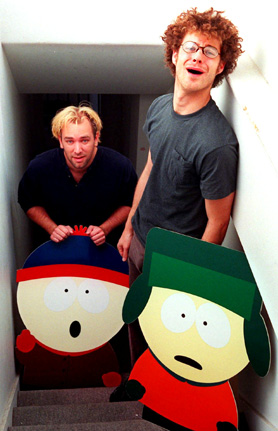
Creators Trey Parker (left) and Matt Stone
THE ``SOUTH PARK'' FILE
Creators: Matt Stone and Trey Parker
Background: The former film students were asked to create a video Christmas card for a Fox Video. ``The Spirit of Christmas,'' completed for $3,000, was quickly circulated in television circles. Ratings-starved Comedy Central gave Stone and Parker a 13-episode contract.
Main characters: Grade-schoolers Kenny, Kyle, Cartman, Stan and Wendy Testaburger.
Adult Characters: Mr. Garrison, the teacher who communicates through his hand puppet; Big Gay Al, who runs a foster home for homosexual animals; Jesus, the white-robed messiah who has his own public-access television show; Chef, who sings sexually explicit love songs in the cafeteria.
GQ (gross-out quotient): Cartman has flaming flatulence. Kyle barfs any time he sees his heartthrob, Wendy. Kenny is murdered in every episode. There's a character who's a piece of feces. Give it an 8.
--Lyle Harris
THE RATINGS War OVER South Park BY RICHARD HUFF New York Daily News Comedy Central's animated series "South Park" on cable is 1 not television just the these hottest days. It's also the only weekly program on any kind of TV to carry the TV-MA rating, which under the new labeling is the designation for mature programming that could be unsuitable for children under 17. In other words, based on the rating label applied by Comedy Central, this show about a group of foul-mouthed grammar school kids is not for kids. That said, according to a New York Daily News' examination of the program's ratings dating back to August, roughly 6 percent of those watching are between the ages of 2 and 11. About 22 percent are between 12 and 17.
Looking at Nielsen numbers for the last four episodes the show's highest-rated efforts so far some 280,000 kids 2-11 are setside. For comparison, NBC's "Law Order," the top-rated broadcast show airing in "South Park's" Wednesday 9 p.m. time period, draws 560,000 kids 2-11, about 3.9 percent of its total audience of 1 14.4 million viewers. (Nielsen estimates that 6.55 million 2-11s are watching television Wednesdays at 9.) According to Peggy Charren, founder of parents to what's in a show before their kids Action for Children's Television, young kids actually watch it. More importantly, the are often left in front of the TV while system was created to work with the V-chip, inappropriate programming is airing.
The a device that will allow parents to block out issue, she explains, is whether they're unwanted shows. That, however, won't be paying attention to what's on. available for six months or more. "I have a feeling more kids are paying Nevertheless, according to a recent attention to 'South Park' than R-rated Associated Press poll, parents movies," Charren said. overwhelmingly ignore content ratings.
Specifically, Charren finds fault with the Probably not kids, though. And with show's tone, the way the kids talk to each "South Park," the TV-MA rating may be serving other and the way they toss around racial as a magnet to younger viewers. slurs. "It's the they use in ordinary Dale Kunkel, a professor of words life, the cafeteria, in the school room, that's communications at the University of dangerous to the democracy," she said. California, Santa Barbara, wonders whether Doug Herzog, president of Comedy Comedy Central is being disingenuous with Central, agrees that under-17s shouldn't be its of the watching, and doesn't allow his own kids to application rating.
do so. But he doesn't apologize for the "Clearly, much of the humor and the whole orientation of the show is adolescentshow's brazen content. "We have done everything we can to oriented humor, rejecting authority, flouting position this as an adult program," convention," Kunkel said. "They say they he said. "It's adult it's don't want the program on an network; teen audience, yet the nature preceded by a disclaimer; it's not even of the content is significantly targeted to promoted during daytime hours.
We have appeal to that audience." done everything we can do to tell the world Indeed, a broadcast standards executive at this is not for your a rival network suggests that Comedy "South Park" debuted last August and Central may be keeping the MA rating on almost immediately became a cult hit with all the "South Park" episodes as a lure to the college age kids who now make up just kids, even though not all episodes are over half its audience. It has now grown into deserving of it. a full-blown TV phenomenon "This is a TV-MA show, this is a show The less-than-MA viewership for the however, that raises questions about the that's pushing the limits week in and week outrageously profane "South Park" is newly installed content ratings. out," said Herzog. "I don't think we're troubling to children's TV experts.
That labeling was designed to alert overrating this."
TV Stretches Limits of Taste, to Little Outcry (April 6, 1998)
Like a child acting outrageously naughty to see how far he can push his parents, mainstream television this season is flaunting the most vulgar and explicit sex, language and behavior that it has ever sent into American homes. And as sometimes happens with the spoiled child, the tactic works: attention is being paid.
Ratings are high, few advertisers are rebelling against even the most provocative shows, and more and more parents seem to have given up resisting their children in squabbles over television. Often, in a nation of two-income families and single parents, children are left alone to watch whatever they want.
This season's stretching of the boundaries of taste has reignited opposition from some public figures who have long complained about television's influence on what they call family values. And some teachers and school principals have sent notes home, warning parents about certain shows, like the cartoon ''South Park.'' But the outcry seems fainter and less widespread than it has in the past.
'South Park,'' the most popular show on cable, features four dirty-talking third graders who poison Granddad, promote a boxing match between Jesus and Satan, and converse with a talking pile of stool called ''Mr. Hankey the Christmas Poo.''
On the hottest new show among teen-agers, WB's prime-time drama ''Dawson's Creek,'' one of the lead characters, a high school boy, had a sexual affair with his English teacher; another boy, a football star, was mocked by some girls for being impotent.
''The Jerry Springer Show,'' a daytime talk show that has cranked up its formula of sexual betrayal followed by fisticuffs, has begun to challenge ''Oprah,'' the queen of the genre, for the No. 1 ranking in daytime viewership. And it has grown so popular with teen-agers that MTV featured two ''Jerry Springer Break'' shows on its annual spring-break weekend in March.
After ''South Park,'' the two most popular series on cable are professional wrestling, which appeal to children as much as to adults. Half the top 30 programs on cable during the first quarter this year were wrestling; the two wrestling series rank among the top six favorite cable shows of teen-agers.
And last week Howard Stern, the most infamous of the radio ''shock-jocks,'' announced that he would begin a late-night television version of his show on CBS stations to compete with ''Saturday Night Live,'' starting in August.
''I'd say there's been a quantum leap downward this year in terms of adolescent, vulgar language and attempts to treat sexuality in shocking terms,'' said Robert Lichter, director of the Center for Media and Public Affairs, a nonpartisan research group in Washington. ''People used to complain that television was aimed at the mind of a 12-year-old. Now it seems aimed at the hormones of a 14-year-old.''
Tomorrow, at the annual convention of the National Association of Broadcasters in Las Vegas, Nev., Sen. Joseph I. Lieberman, a Connecticut Democrat, and William Bennett, the conservative Republican commentator and lobbyist, plan to speak out, as they did two years ago, to condemn sexually lurid talk shows. They will urge station owners to drop ''The Jerry Springer Show'' in particular and to adopt a voluntary ''code of conduct'' enabling stations to collaborate in restricting vulgar programming without fear of losing a competitive edge.
''If they need an exemption from antitrust prosecution for that, I bet it would fly through both houses of Congress,'' Mr. Lieberman said.
But interviews with parents around the country last week suggested that many families are not as acutely distressed about television vulgarity as Mr. Lieberman and Mr. Bennett are.
Some parents say their children, raised in a multiple-channel universe, are savvy enough about television not to be overly influenced by it. Some argue that real-life issues and foul language confront children anyway.
''I don't think parents have given up caring, but they've almost given up fighting,'' Mr. Lichter said. ''Popular culture is so ubiquitous it's almost impossible to combat. It's like the weather, everyone complains about it but no one does anything.''
Television is not alone in the liberal use of sexual content. In music, four-letter words and sexual bravado are common, not only in rap but also in mainstream rock. Even the most popular movie of the year, ''Titanic,'' which was seen by millions of children, had a scene in which the female lead appeared topless.
Network executives tend to dispute that anyone is deliberately pushing the envelope of pop-culture propriety to attract viewers. Stations and cable operators make the calls on what is acceptable fare, and they say television reflects the culture, which has grown more permissive, and that the provocative themes in certain shows arise from isolated circumstances. Among the explanations offered:
*''South Park'' is on Comedy Central, a network whose vitality depends on discovering new, attention-getting comedic forms and talents.
*''Dawson's Creek'' is on WB, a network whose avowed business strategy is to appeal to teen-age and young-adult audiences more than other networks do.
*''The Jerry Springer Show'' has grown more violent and has seen Nielsen ratings grow, but no single network is responsible because the show is sold in syndication, station by station.
*Pro wrestling has long been popular, but now there is competition between the World Wrestling Federation (on USA) and World Championship Wrestling (on TNT), which has led to dueling levels of viciousness in the staged bouts.
Some of the bouts between Jerry Springer's guests are obviously staged, too, and have become a cult attraction for college students, as evidenced by his appearance on MTV, where research into the tastes of teen-agers and young adults is minutely detailed, intensive and constant.
Mr. Springer's MTV shows included one in which a young man and woman told the woman's boyfriend that they were sleeping together (the two men got into a fistfight), and one where the host offered people $1 to do kinky things like dance naked in front of the audience (with appropriate blurring to make the segment suitable for television).
''The rationale was, he's very much of the moment and has a much younger audience than anyone thought,'' said Judy McGrath, president of MTV. ''He's someone our viewers are talking about. And these were college students, not high school, and spring break is a college bacchanalian experience.''
College students are the target audience for ''South Park,'' too. Comedy Central schedules it at 10 P.M. with a TV-MA rating (not for viewers under 18), but many children and adolescents watch it.
Drew Skillman, a 17-year-old in Bellevue, Wash., argued that ''South Park'' has an original and even sophisticated political humor that adults may miss. He likes the way it makes racist, ethnic and sexist jokes indiscriminately.
''It breaks the politically correct rules that are all over TV right now,'' he said. ''My friends and I, it's not like we want to be racist or anything, but they poke fun at everybody. It's refreshing, it's no-holds-barred.''
Younger boys like it for simpler reasons: the flatulence jokes. Those jokes ''really made me laugh because it was so in tune with my son,'' said Janet Ceja-Orozco of El Cerrito, Calif., who has an 11-year-old son and a 13-year-old daughter. She said she was far more concerned that so many of her children's friends watch ''Jerry Springer.'' Her school district has a year-round system, with three-week breaks scattered through the year; many children are home alone in the daytime.
''My kids and their friends are all talking about it,'' she said. ''They know what time it's on in the morning, and that it's repeated late at night, and they tell me their friends stay up to watch it. I think it's awful, these people beating each other up all the time and the sexual stuff -- 'my husband slept with my best friend' -- but they do watch it. Then we talk about it. We talk about how low people can go.''
Indeed, some parents said a consoling factor about the sexually explicit shows is the opportunity they provide to talk about such subjects.
On a recent episode of ''Dawson's Creek,'' some girls made fun of a football player by spreading the word that he ''couldn't fertilize a garden'' and ''gets a soft spot for the ladies -- in a very unfortunate location.''
Jamie Kellner, president of the WB Network, said parents should be realistic.
''It's the way high school kids actually do talk to each other,'' he said. ''You can watch with your kids and be let in and learn about it, or you can hide from it, but this world exists and your kids are into it.''
He also emphasized that the show's hero, Dawson, ''is a virgin who has chosen not to have sex, who is also anti-drug and anti-smoking, and believes marriage is a sacred institution.''
But what of Pacey, the young man who had an affair with his teacher? Mr. Kellner said the episode ultimately sent a positive message because the teacher lost her job and Pacey was ostracized at school.
Whether it matches most high school students' experience or not, ''Dawson's Creek'' has captured their attention. Since its debut on Jan. 20, it has vaulted to the No. 2 spot among teen-agers, behind ''The Simpsons,'' on Fox.
In Seattle, one group of 15-year-olds has a ''Dawson's Creek''-watching party each Tuesday, despite the reluctance of their parents.
''We tried to put the kibosh on it,'' said Nancy Stokley, whose daughter has had friends over to watch it and has gone to others' homes. ''We said, 'Hey, this is a school night, you know, this is ridiculous.' But they are all quite into it. It has hit a nerve.''
Carol Orme-Jackson, of Cambridge, Mass., also found out through a reporter's inquiries that her 14-year-old daughter watches ''Dawson's Creek'' at friends' houses. Ms. Orme-Jackson said she was not worried by the talk about sex per se, but ''that this kind of trashy life style becomes glamourized.''
Some parents say children learn to idolize the wrong sorts of people and life styles. Others say children know the difference between reality and the fictional world of television.
Some experts worry that young people will be desensitized to meanness and sexual risks. Michael Cohen, a developmental psychologist and partner in a New York City research firm, Arc Consulting, shares that concern but said not enough research has been done to draw conclusions.
But many parents today believe battling with their children about television is almost pointless, given the antisocial humor, foul language and sexual innuendo young people hear everywhere else.
''It's part of life,'' said Katherine Mahoney, a mother of two teen-agers in Cambridge, Mass. ''I'm of the notion that life is a soap opera.''
TV Notes; Curfew in 'South Park (March 11, 1998)
Tomorrow the Federal Communications Commission is expected to put its stamp of approval on the ratings system being used by most television networks to alert parents to sex, violence or foul language and on plans to enable parents eventually to block out offensive programs by using a V-chip.
The F.C.C. is also expected to issue technical rules so that manufacturers can proceed with adding V-chip devices to every new television set, as required by law.
All this could be bad news for Comedy Central, the cable network with the good fortune to be showing the most popular series on cable at the moment, ''South Park,'' a cartoon about foulmouthed third-graders that has become a runaway cult hit. Parents who use their V-chip to block all shows with a TV-MA rating (the strictest, for programs not suitable for anyone under 17) will automatically block ''South Park'' -- which is popular enough with children under 17 that they make up about one-fifth of its audience.
Comedy Central puts a TV-MA rating on ''South Park'' because the characters use extremely vulgar language, make scatalogical jokes and commit despicable violence against each other (one, Kenny, is killed in every episode). The show has featured a creature called ''Mr. Hanky the Christmas Poo,'' and a boxing match between Jesus and Satan. It is apparently the only regular series on television with a TV-MA rating.
''It's a show for mature audiences, for adult audiences, and we really don't think kids should be watching it,'' Doug Herzog, the president and chief executive officer of Comedy Central, said yesterday, adding that only 6 percent of its viewers are under 11. The show appears at 10 P.M. on Wednesdays.
Parents who block TV-MA shows may face an uprising from their older children and teen-agers, who know it is cool to watch ''South Park.'' ''If there's a lockout device that causes a conversation between a child and a parent, I think that's good,'' Mr. Herzog said. ''And if kids are going to watch it, I'd prefer they watch with their parents, so it can be discussed and maybe put in context.''
He mentioned another benefit of the ratings system. ''We have an obligation to the show's creators, too,'' he said. ''We don't want them to change their vision and water it down, feeling that they have to do this or that to get a TV-14 rating. The rating gives us the opportunity not to blindside viewers.'' LAWRIE MIFFLIN
The V-Chip Arrives With a Thud (11/4/99)
WITH KENNY dying a violent death in almost every ''South Park'' episode, wrestlers on cable channels engaging in round-the-clock head-banging and plenty of bare skin showing in prime time, it is not surprising that many parents find a lot of what is on television unfit for their children.
But when offered something that would block violent or racy shows, would parents actually use it?
It seems not, if the arrival of the V-chip is any indication. The V-chip, circuitry that can be used to block broadcasts according to a ratings system, quickly gained the support of Congress and parents' groups in the mid-1990's after it was developed by Tim Collings, a Canadian professor and engineer. As of July 1, the Federal Communications Commission, carrying out a mandate from Congress, has required manufacturers to include a V-chip in half of their televisions with screens that are 13 inches or larger. By January, all of the roughly 20 million sets in those sizes sold in the United States each year will be required to have one.
But whether it is because of a lack of consumer awareness, or because it is difficult to use or because parents do not feel they need it, the V-chip has few users, judging by interviews with retailers, industry experts and consumers. Even groups that support the V-chip acknowledge that it has yet to catch on with the public.
''We're very supportive of it, but there's very little real media information about it,'' said Ginny Markell, president of the National P.T.A. ''There's a huge percentage of the population that's unaware that it's even available, and unless a family's in the market for a new TV, it's not on their radar.''
Proponents of the V-chip and the ratings system say they can be useful aids to parents in controlling what their children watch. But the federal mandate is viewed by many manufacturers, broadcasters and parents as unwanted government interference.
''We didn't feel it was applicable to us, because a lot of our programming is music videos,'' said Greg King, a spokesman for Black Entertainment Television, a cable broadcaster that does not use the ratings system, which is voluntary. ''But once you go ahead with a ratings system, it makes you wonder what's next, as far as censorship goes.''
Russ Neuman, a professor at the Annenberg School for Communication at the University of Pennsylvania, said that the V-chip ''became about politics and economics rather than children and viewing.''
''However well intentioned it was at its inception,'' Professor Neuman added, ''it may not have anywhere near the effect of its intended purpose.''
Retailers say that consumer interest in the V-chip is lukewarm and that the technology is hardly much of a selling point for televisions with the latest gee-whiz features like picture-in-picture and Dolby sound.
''It's not on the tip of people's minds right now,'' said Michael Perlman, president of BrandsMart USA, a Miami-based retail chain.
''It doesn't really surprise me that we're not seeing people coming in droves to get it,'' said Dave Arland, a spokesman for Thomson Consumer Electronics, based in Indianapolis, which manufactures RCA and General Electric TV's. ''It's not something that America was clamoring for. It's something that Congress was clamoring for.''
Mr. Arland said that although the chip adds only minimally to the price of a television, Thomson would have preferred to offer it as an added feature for those who really wanted it.
When asked in a telephone interview whether she had heard of the V-chip, Lisa Albinus, a mother of two preschoolers in Harrisburg, N.C., said, ''Is it something you use to identify your children?''
Upon learning what the V-chip could do, she responded: ''I'd still want to watch the shows myself. 'Rugrats' is rated for kids but they show them how to throw food and be disobedient to their parents.''
Others, like Rachel Leventhal, who is the mother of a 2-year-old and was shopping at a Circuit City store in Manhattan on a recent Sunday, had heard of the V-chip, but were unaware that it was available.
''It might be something I think about in a few years,'' Ms. Leventhal said. ''Hopefully, they'll make a better one by then.''
Gloria Tristani, an F.C.C. commissioner and chairwoman of the V-Chip Task Force, which was put together in May, acknowledged that lack of awareness was a problem. ''It's hard to get people to use something if they don't know it exists,'' she said, ''so the major problem is getting information out there.''
Ms. Tristani added that the task force was urging retailers to publish flyers about the V-chip and that broadcast associations and networks would be sponsoring public service announcements about it in November to coincide with the holiday shopping season.
Retailers including The Wiz, Sears and BrandsMart USA have not run advertisements about the V-chip's availability, partly, they say, because of the lack of consumer interest.
The rating system itself, which was developed by representatives of the National Association of Broadcasters, the National Cable Television Association and the Motion Picture Association of America, can be difficult to understand, with six basic ratings that can be subdivided for specific content like adult language or violence. And because the networks rate their own programs, what constitutes suggestive dialogue on one network might not on another.
Broadcasters that use the system play down the problems. ''There was some initial concern that the ratings system might be a little complicated,'' said Julie Hoover, a spokeswoman for ABC, ''but we've trained our editors and we're very comfortable with the internal consistency of the ratings within our department. If a parent watches a little programming and gets familiar with the ratings, it becomes pretty clear what the designations are.''
But others outside the broadcast industry have a less charitable view of the ratings system, believing that it is purposely complex.
''It's in the interest of the broadcasters to make the V-chip technology as useless as possible so that it wouldn't ever eliminate any potential audience,'' Mr. Neuman said. ''That's the economics of box office ratings, as well as the ratings for television.''
The idea of using technology to help parents control what their children watch has long had support in Congress, which in 1996 overwhelmingly passed a law overhauling the communications industry that included the requirement that V-chips be added to televisions. And in surveys, parents have applauded the V-chip, at least in theory. In the latest such poll, of 1,000 parents conducted this year by the Henry J. Kaiser Family Foundation, an independent national health care philanthropy, 77 percent said they would use the V-chip if they had one. But that theoretical support has not translated into use.
Many parents believe that monitoring their children's television viewing is their responsibility and bristle at the notion that they need a V-chip. ''I don't know how the V-chip works, but I don't really trust that someone else is going to have better judgment than we will,'' said Kevin Mann of Brockport, N.Y., who has a 6-year-old daughter.
''I realize that most parents have jobs and can't be with their kids at all times, but the V-chip is just one more instance where parents are being given the opportunity to relegate their responsibility to someone or something else,'' said Mike Jenkins, of Dublin, Ohio, whose 11-year-old daughter watches television only when accompanied by her parents.
But advocates of the V-chip say it can be an effective tool for keeping young children from stumbling across something they should not see. Joanne Cantor, a children's media consultant and the author of ''Mommy I'm Scared: How TV and Movies Frighten Children, and What We Can Do to Protect Them'' (Harcourt Brace, 1998), uses an RCA television on loan from Thomson Consumer Electronics to block some programs and movies for her 10-year-old son. ''I pretty well trust him,'' Ms. Cantor said. ''I think of the V-chip as less of a policing function and more of a protecting function.''
But parents who want to use the V-chip will find the system difficult to set up. With most televisions, the V-chip can be programmed by pressing the menu button on the remote control. (On some models, the chip is programmed with controls on the surface of the television set.) The parent chooses a personal identification number, or lock code, which allows the parent to activate, deactivate and change the controls.
Parents can select as few or as many of the six program ratings in the scale that they want to allow. For example, by selecting only programs that are rated TV-Y (for children of all ages), any program with a rating of TV-Y7 (for children age 7 and older), TV-14 (for children 14 and older) or TV-MA (for a mature audience only) will be blocked. Without the lock code, children cannot change the programming selections.
Content descriptors, which were added to the age-based ratings in negotiations with child advocacy groups in July 1997, signify the presence of violence (V), sexual situations (S), coarse language (L), suggestive dialogue (D) or fantasy violence (FV), which is defined as ''fighting presented in an exciting -- even thrilling -- way.''
Although not indecipherable, the V-chip and the ratings system take time to understand how to use. When presented on the screen and in program listings, the boxes of letters and numbers for the rating resemble something you might recite for an eye doctor.
Industry analysts say the system's complexity contributes to consumers' ambivalence. ''The V-chip's user interface and the rating systems are not particularly intuitive or convenient,'' said Jay Srivatsa, senior industry analyst at Dataquest, a research firm in San Jose, Calif. ''If people can't figure out how to use it within a few minutes, they might not bother.''
Although the system is far from perfect, parents need to learn how to use it, said Jeff Chester, executive director of the Center for Media Education, which publishes a guide to the V-chip (www.vchipeducation.org).
''Parents are going to have to get used to this alphabet soup of guides telling them what's in the content,'' he said, ''as we enter the digital age and Internet content becomes available on TV. The V-chip is the first formal development in what will be a heavily rated media world.''
Photos: Joanne Cantor says she uses the V-chip to protect, not police, her son, Alex Larsen, 10. (Andy Manis for The New York Times)(pg. G8); The V-chip allows parents to block certain types of programs, using a remote control. (Andy Manis for The New York Times)(pg. G1)
Television: Lowbrow and proud of it (March 29, 1998)
'South Park' is the biggest thing in American animation since 'The Simpsons' - only it's cruder, and all about children, and punkishly rude. Dennis Lim chats to its co-creator, Matt Stone about
"KIDS ARE NOT nice, innocent, flower-loving little rainbow children," observes Matt Stone, one half of this year's most prodigious and least likely American success stories. Calling from the set of David Zucker's sports comedy BASEketball (in which he has his first Hollywood starring role), the 26-year-old co-creator of South Park, the biggest animation sensation since The Simpsons, doesn't mince words. "Kids are all little bastards: they don't have any kind of social tact or etiquette, they're just complete little raging bastards."
And so it proves week after week in the crude and crudely drawn South Park. Frequently described as "Peanuts on acid", the supremely warped creation of Stone and Trey Parker, his 28-year-old partner in crime, centres on four foul-mouthed nine-year- olds whose misadventures feature (and this is by no means an exhaustive list) UFO sightings, alien kidnappings, genetic engineering, firearms, crack, anal probes, explosive diarrhoea, flaming flatulence, gay pets, mutant turkeys, flesh-eating zombies, a homicidal hand puppet, and, most notoriously, a talking turd.
When it premiered on the US cable network Comedy Central in August 1997, it was clear that South Park's underground days were numbered. Within six months, it was a full-blown, massively hyped, aggressively merchandised pop-cultural phenomenon. Record ratings for a cable programme; covers of Newsweek, Rolling Stone and Spin; $30m in T-shirt sales. Parker and Stone appear together in two feature films scheduled for US release later this year: BASEketball and Orgazmo, a recent Sundance entry about a devout Mormon turned porn star, which they co-wrote and Parker directed. In addition, they're being paid $1.5 million to write a prequel to the hit Jim Carrey no-brainer Dumb and Dumber, and are negotiating a deal for a South Park feature. A South Park soundtrack album is looming, featuring the likes of Beck and Fiona Apple. A possible record deal awaits Parker and Stone's band DVDA (Double Vaginal Double Anal - "a porn term," Stone explains). And the escalating merchandising madness threatens to yield a chocolate bar inspired by Mr Hankey, the all-singing, all-dancing Christmas poo.
How this all started is already the stuff of legend. Two years ago, Parker and Stone acquired a small but loyal following when they made The Spirit of Christmas, a much-bootlegged short film (still widely available on the Internet) that was commissioned by a studio executive as a seasonal video greeting. The five-minute clip established the groundwork for South Park, succinctly introducing its characters - Stan (relatively well-adjusted ringleader), Kyle (Jewish, slightly neurotic), Cartman (fat, easily provoked, shockingly profane), and Kenny (permanently hooded, completely incomprehensible, prone to grisly accidents) - and its chief hallmark: vaguely surrealist iconoclasm (the kids watch in horror as Jesus and Santa Claus come to blows over the meaning of Christmas - at the local mall, no less).
Although The Spirit of Christmas features such decidedly untelevisable lines as "Dude, don't say 'pigfucker' in front of Jesus", Stone claims that it wasn't difficult to housebreak their creation for mass consumption. "Every once in a while, we'd love to be able to say "fuck" or "shit", but other than that, we haven't really had to tone down the show. We tackle the subject matter we want to. Comedy Central wouldn't let us do an episode on the Nation of Islam - I think they were just afraid for our safety - but more often, we're surprised at what they let us get away with."
So far, Stone and Parker have been getting away with scatological humour, celebrity-bashing, and, most impressive of all, thoughtful explorations of awkward themes. The show is irresistible, at once incisive and deranged, when delving into prepubescent confusion - Kyle's bewilderment as a Jewish kid in Colorado at Christmas-time, or Stan's mixed feelings when he finds out that his dog, voiced by George Clooney, is gay (the episode in question has been nominated for an award by the Gay and Lesbian Alliance Against Defamation: it takes 30 minutes to arrive at the same message that took Ellen DeGeneres a season of nervous tics).
South Park's crude, attention-grabbing transgressions make it easy for ome to dismiss it as lowbrow comedy - a notion that Stone doesn't have time for. "I don't see how there can be a class system to comedy," he snaps. "If it makes you laugh, then who cares if it's a fart or a joke about Oscar Wilde? Is it hitting a different part of your brain if it's lowbrow or highbrow?" Just as misguidedly, South Park is often celebrated as an attack on political correctness, when it's more accurate to think of the show as an equal-opportunity offender. Stone says there's no agenda behind the insults. "I don't give a shit about being PC or anti-PC," he says. "We tackle subject matter that we think is funny and unique. We make statements through our humour, but we're not out to make statements. It's never, 'Let's do a show about homosexuality' or whatever. We have our viewpoints, but we don't proselytise, we're just in it to make people laugh."
One favoured device is offhand pop-cultural references: to convey the horrors of ageing, Stan's grandfather forces him to listen to Enya; when his baby brother is abducted by aliens, Kyle urges him to dive off the spaceship by yelling, "Do your impression of David Caruso's career!" (Caruso reportedly found this so amusing that he's asked to do a guest voice); and in South Park's version of Armageddon, evil is represented by Barbra Streisand, good by Robert Smith of The Cure (Smith strolls off into the sunset, while little Kyle shouts after him, "Disintegration is the best album ever!").
Parker and Stone don't necessarily play fair, often randomly resurrecting long-forgotten stars for gratuitous public maulings - in one episode, stocky former sitcom actress and Save the Children spokeswoman Sally Struthers is discovered stuffing her face in Africa, and promptly roasted by villagers ("She's asking for it," Stone remarks drily). The brutally chipper morning talk-show host Kathie Lee Gifford is spared, however, when an assassination attempt by the boys' troubled teacher, Mr Garrison, goes awry. "We would have killed her," says Stone, "but we didn't want Garrison to be a murderer. It would have really changed his character if he'd actually killed another human being, even if it was Kathie Lee."
Perversely, this cheap dig hints at how carefully thought-out the show is. "We feel protective of the kids, but not in some creepy way, and we definitely feel protective of their world," says Stone. "There's a cohesiveness to it that we wouldn't want to break. The world has a logic of its own, which gets more developed every week." Indeed, the fictitious, wintry town of South Park, Colorado - where the main drag boasts a prominent rhinoplasty clinic, and Jesus hosts a call-in TV show titled Jesus and Pals - is the most fascinating slice of small-town America we've encountered since Twin Peaks. Alarmingly, a Colorado resident recently told the Associated Press, "It isn't a comedy. It's a documentary."
On the whole, the show has made surprisingly few enemies. A Connecticut high school tried to ban South Park T-shirts, but otherwise, disapproving voices - mostly concerned with the potential corruption of children - seem largely to have been egged on by journalists in search of a "balanced" story. Stone, for one, thinks that younger viewers - not the target audience, admittedly - are more sophisticated than people think. "This kid that we know came up with a skit for a school report to show how blacks and whites were segregated on the buses, and Cartman was the bus driver. The kid's favourite character is Cartman, but he knows that Cartman's a racist bastard. I thought that was really cool." South Park offers a brutally honest and strangely poignant view of childhood, presenting it as, more than anything else, a continuous erosion of innocence. As Stone puts it, "I think the show's just a little upsetting to people who have an idyllic vision of what kids are like."
Should the shit suddenly hit the fan, Parker and Stone have already prepared their defence, judging by one episode in which the parents of South Park launch a kamikaze protest against Terrence and Philip, a fart- fixated animated-show-within-the-show (the equivalent of Itchy and Scratchie in The Simpsons); an exasperated Stan, in a sudden burst of cogency, notes, "If parents would spend less time worrying about what their kids watch on TV and more time worrying about what's going on in their kids' lives, this world would be a much better place."
Education
School labels South Park 'filth' (January 6, 1999)

"Filth of a most unsavoury nature," according to school
A public school is urging parents to stop their children watching the late-night cartoon, South Park, saying it is "filth"
The King's School in Ely, Cambridgeshire, has written to parents telling them that the school-based cartoon is "filth of a most unsavoury nature" and should not be watched by younger children.
The school's development director, Martin Horrox, says that the show is "rude the whole way through" and its "toilet humour" is being imitated by pupils. As such the school has advised parents that they might want to protect their children from its adverse influence.
| "Toilet humour" imitated |
In a newsletter sent to parents, the school warned that South Park "contains obscenities, swearing, lavatorial actions and filth of a most unsavoury nature. Unfortunately it is widely admired by many children, particularly boys, in Years 7 and 8 (ages 11-12). This cannot be right".
The newsletter urges parents that they should "make every effort to prevent and defend their children from seeing these programmes".
But the American-produced programme, broadcast on Channel 4, continues to be popular in the school's playground.
"Once word goes out that something is cool, children will want to watch it, although we suspect that fewer have watched it than claim to have," said Mr Horrox.
Watershed
While older children can make up their own minds about what they watch, Mr Horrox says South Park is "not appropriate" for pupils under the age of 12. In support of the school's stand, he says that the programme's video has a 15 certificate.
The advice from the school has not caused any controversy among parents, he says, with the only feedback showing support for the cartoon warning.
"If the school had said nothing to parents we might have been thought to condone behaviour that falls below our normal standards."
A spokesman for Channel 4, which is to screen a new series of South Park in the spring, said the programme was broadcast "very post-watershed" and was not marketed at children.
"If children are watching after 11pm then parents have to take responsibility. It's not intended as a children's programme."

Cartman top with kids (August 26, 1999)
Role model? Me? South Park's Cartman takes centre stage
Eric Cartman, the animated outcast in the South Park cartoon series, has been named favourite personality in a poll of children.
The obscenity-spouting character pipped a host of pop stars, footballers and actors to top the list compiled by the NatWest Bank
Kenny, another star of the controversial post-watershed series, was also included in the top 10, along with fellow animated hero Bart Simpson.
Do you think Cartman is a suitable role model for children? Who would you choose? Click here to tell us
The children polled, aged between eight and nine years old, put the irreverent cartoon rascals on a par with more traditional role models such as soccer ace David Beckham and pop sensation Britney Spears.
The children polled, aged between eight and nine years old, put the irreverent cartoon rascals on a par with more traditional role models such as soccer ace David Beckham and pop sensation Britney Spears.
The cast of US sitcom Friends also fared well in the vote. Jennifer Aniston and Courteney Cox both managed respectable placings in the final table
The success of Cartman and Kenny, sources of the more risqué jokes in the cult animation, came at the expense of figures in mainstream children's television.
Blue Peter presenter Katy Hill was the only figure in the top 10 personalities to represent a show specifically aimed at children.
Traditionalists may be heartened to hear that secret agent James Bond still enjoys the admiration of young people - 007 scraped in at number 10.
Despite the vote of confidence in their heroes, children will not be allowed to see the latest instalment of Cartman and Kelly's adventures. The new South Park film, opening on 27 August, has been given a 15 certificate in the UK
| Kenny lost for words at seventh place |
South Park: Bigger, Longer and Uncut ran into trouble in the United States, with the censor cutting scenes to remove bad language.
"Every time they made us cut something, we added something that was 10 times worse," said a defiant Trey Parker, one of the twentysomethings behind the cult show.
A US company named the film the most profane film ever, out-swearing the previous title-holder Pulp Fiction.
Media Index claimed the movie packed 399 "bad words" and 128 "crude gestures" into just 80 minutes.
The South Park film was eventually released in America with an 'R' rating - meaning cinemagoers under 17 had to be accompanied by an adult.
Fuelled by screenings on Sky and Channel 4, South Park has become a playground cult in the UK.
The headmaster of a Cambridgeshire public school even went as far as to appeal to parents to ban their children from watching the show.
| What's wrong with me? Stan's not the man |
He described the series about nine-year-old Cartman, Kenny, Kyle and Stan as "filth of the most unsavoury nature".
The NatWest poll seems to suggest that youngsters identify more strongly with their South Park counterparts than parents would perhaps like
"The show's just a little upsetting to people who have an idyllic vision of what kids are like," reckons Matt Stone, the show's co-creator.
"Kids are not nice, innocent, flower-loving little rainbow children. Kids are all little bastards; they don't have any kind of social tact or etiquette."
Goin' Down to South Park (May 2000)
How kids can learn from "vile trash."
I confess: I let my kids watch South Park. Not every episode, mind you–I prescreen the shows on video before I watch them with the family. But when my face lands on the cover of Negligent Father magazine, that'll be the headline: He Lets His Kids Watch South Park. My kids have taken in four episodes of this foul-mouthed cartoon about life in a "redneck mountain town." They've seen young Kenny get eaten by rats. They've watched a cute little bear get blown to smithereens, seen a boy toast marshmallows over a burning Vietnam Vet, and heard another call his school bus driver a "fat ugly bitch."
I can't help it: I am what I am. I'm tired of living a closeted life. I expose my kids to the traditional fixtures of American family entertainment, but they also know the cultural icons of South Park. So they're familiar both with venerable kids' show host Mister Rogers and with South Park's Mr. Hat. Some of the best times we've had as a family have been sitting around the dinner table, repeating bits from South Park and laughing hysterically.
It's not easy for me to admit this, living in Colorado Springs, Colorado. We're only a few miles down the road from Focus on the Family, an evangelical Christian ministry. Focus thinks American popular culture is a moral sewer and South Park is its lead exhibit. Writing in Plugged In, the group's youth culture magazine, critic Bob Smithouser calls the show "twisted," "extremely mean-spirited," and "deplorable." He concludes, "South Park's own tongue-in-cheek disclaimer may be the most accurate warning of all: 'The following program…should not be viewed by anyone.' We heartily agree."
The Christian Family Network–a group whose "mission" is to "advance Christ-centered values, restore morality, and protect life for the individual, family, and community"–goes even further. It has prepared a South Park Education/Action Guide to "help make people aware of South Park and its potential affect [sic] upon our youth." "Working together," the authors write, "we can help protect our youth from vile trash like South Park."
That's what they think. Some of us feel otherwise.
Good parenting is an ongoing process. You're constantly exposing your children to new ideas, developing their moral character, and helping them realize their potential, all the while preparing them for a world that doesn't necessarily share your values. If you expose them to unfiltered adult issues before they've accumulated enough life experience and emotional maturity to deal with them, it may indeed be harmful.
But complete isolation from pop culture is just as bad. Forbidden fruit is always more tempting, and isolation can keep you from discussing important issues with your children. That, in turn, impairs their ability to make judgments later in life. How can they make important choices as adults if they haven't had any practice?
When South Park first aired, back in 1997, it caused quite a stir out here and in the rest of the country. During the first season, one Georgia principal banned South Park clothes, while the founder of a group called Action for Children's Television denounced it as "dangerous to the democracy."
It turned out that lots of people like to watch cute but crudely drawn third-graders curse and spout social commentary far beyond their years. It wasn't too long before my two kids, currently 10 and 12, were asking what all the excitement was about and whether they could watch the show. We don't watch TV, but I told them I'd preview a couple of episodes first. If I found some I thought they were ready for, I'd bring them home on video and we'd watch them together. That seemed to satisfy them.
The first time I watched the show, I couldn't remember the last time I'd laughed so hard. The dialogue was outrageously funny; the writers' barbs were accurate and timely. I wound up watching almost all the episodes, finally settling on four I thought our family would enjoy. The kids loved them, and we've never looked back.
So am I a bad parent? Am I, to quote the Christian Family Network, showing my children "a steady stream of violence…that poisons as surely as if they swallowed it"? I don't think so. I feel pretty good about my kids, and I feel pretty good about South Park.
Contrary to popular belief, South Park is loaded with moral content, whether or not the show's writers planned it that way. It's hard to list all the valuable lessons it has taught my kids, but here are some of my favorites:
It's good to make fun of celebrities. Most episodes contain at least one dig at a famous person–or, sometimes, at someone who just wants to be famous. In "Volcano," TV stalwart Patrick Duffy shows up as a leg on a legendary monster. This prompted howls of laughter from my kids, though I had to explain to them what Step by Step was. (It's his latest series.) In another episode, Bob "Gilligan" Denver makes a fool of himself on a talk show; in another, zaftig Christian Children's Fund pitchwoman Sally Struthers gets caught stuffing herself on food meant for famine relief. Most of the shows with "guest" celebrities drive home the point that actors are just people who are paid to pretend.
It's good to make fun of Barbra Streisand. I guess this falls under making fun of celebrities, but La Streisand is in a class by herself. The episode "Mecha Streisand" spoofs Japanese monster movies. Cartman, one of the 8-year-old boys on whom the show centers, finds a mystical artifact that will make Barbra Streisand ruler of the world. She eventually comes to South Park and gets the artifact from him through cruel and unusual punishment: She chains him up and starts singing. A frenzied Japanese incantation turns Barbra into a mechanical Godzilla, who battles both movie critic Leonard Maltin (as a giant robot) and Sidney Poitier (as a fire-breathing turtle). Only when The Cure's lead singer, Robert Smith, transforms himself into Mothra is evil finally vanquished. (Now that I think of it, my kids are learning a lot about pop culture too.)
It's good to make fun of people who believe stupid things. And not just Barbra Streisand. In "The Mexican Staring Frog of Southern Sri Lanka," the kids hoodwink the hosts of a public access cable show with a hilariously primitive videotape that supposedly shows a mythical creature. The adults eventually come to their senses, and I get to tell my kids what's wrong with believing that something is true just because you want it to be.
It's good to make fun of hypocrisy. In "Conjoined Fetus Lady," we're introduced to the school nurse: She has "Conjoined Twin Myslexia" and was born with a stillborn fetus attached to her head. The script suggests that the handicapped don't want to be singled out for special attention; they just want to lead productive, fulfilled lives. Some "normal" characters talk about wanting to help, but they single the nurse out anyway with a hilariously awful "Conjoined Twin Myslexia Week." It's bad, I tell my kids, to say one thing and do something else.
Things that happen in cartoons aren't real. My kids figured this out long ago, but it's a point worth driving home. Kenny gets killed in almost every episode of South Park, only to reappear the next week with no explanation. If there is any more dramatic way to teach kids that TV is fantasy, I don't know it.
Make no mistake, much of what my evangelical neighbors say about South Park is accurate. Every show contains a lot of profanity and graphic sexual humor. I won't let my kids watch most of the episodes, because they deal with issues they aren't ready for yet. Very young children shouldn't watch the show, because they don't understand context; repeating what they hear could get them in trouble. In fact, I doubt that kids of any age should watch it without their parents sitting there with them. Of course, that's true for virtually everything on TV.
But cultural critics who think shows like South Park are malevolent don't really understand modern life. They seem to think Americans are completely passive consumers, helplessly force-fed a mass media diet that they can't control. Well, they may lead their lives that way, but my family doesn't. In my experience, parents can wield much more influence over what their children see now than they could when I was a kid.
When I was growing up in the '60s, our house had three networks, two TVs, one time when we could watch a television show, and no real choice. We had to watch what was on, when it was on. Today, my house has more than 60 TV channels, every one of which competes with the Internet and the video store down the street. In our house, TV loses so often that we pay our cable bill only so we can get the Weather Channel. (And if we parents do want to watch something on TV, and it doesn't fit our schedules, we can tape it.)
Having more choices wakes you up as a parent: It makes you realize how much you can do for your children, and it helps you shape their environment to be more in tune with your values. It may be counterintuitive, but for an alert parent more options means more control.
Let me stress this again: South Park is no ordinary cartoon. Don't watch it with your kids unless you're prepared to talk about homosexuality, profanity, and fart jokes. Don't show your kids any South Park episode unless you've taken the time to watch the whole thing first, to make sure it's right for your family. You're a parent. That's your job.
But if South Park isn't Sesame Street, it isn't poison either. Given the opportunity, parents can find moral education and artistic value in surprising places–even in a video called "Conjoined Fetus Lady." When our family sits down to dinner and 10-year-old Erica starts riffing on a South Park episode, we share the kind of connection that cultural conservatives claim is all too scarce in American family life. When her big brother Max chimes in with his Cartman imitation and we all start laughing uproariously, that's a moment of closeness I treasure. And it's a moment made possible by the delicious anarchy of American popular culture. If this is a moral sewer, it's one I'm proud to swim in.
New Jersey Principal Warns Parents about South Park by NY Daily News (March 13, 1998)
Though it’s designated for adults only, kids are still tuning into Comedy Central’s animated series.
Just ask Edward Leibfried, principal of the Ocean Road Elementary School in Point Pleasant, NJ.
Having witnessed second and third-graders talking about, and quoting from, the foul-mouthed series and a few wearing “South Park” paraphernalia, Leibfried and fellow educators sent parents a letter warning them of the explicit content of the series. “Part of the difficulty is some were beginning to lose focus in class,” Leibfried told The News. The letter explained “There are surprising number of students [Grades 2 to 5] that this is part of their regular viewing fare.”
So far, response from parents has been good, Leibfried said. As for the kids? It’s been quiet in that regards,” he said. A Comedy Central spokeswoman reiterated the channel’s position that the show is not for kids. In fact, it has put an MA label on it, meant to warn away viewers under 17. “We have done everything to insure parents as much as possible about this show and the contents of this show”, she said.
‘SOUTH PARK’S’ LAUGHINGSTOCK IS RISING: IT’S NO. 1 AGAIN (April 2, 1998)
COMEDY CENTRAL’s crude and lewd animated half-hour series “South Park” once again last week was the highest-rated program in all of basic cable, according to Nielsen statistics released yesterday.
The top-rated performance was the comedy’s sixth such win in the last eight weeks.
“This is very gratifying,” said Doug Herzog, president of Comedy Central. “This is a business of hits, and when you have one it’s an awful lot of fun. I understand everything in this business is cyclical, and this is our cycle.”
“South Park” revolves around a group of foul-mouth misfit grammar school kids living in a fictional town in Colorado.
News of “South Park’s” win came on Comedy Central’s seventh anniversary, which falls appropriately on April Fools Day.
For the week, “South Park” averaged a 6.2 rating (percentage of the 48 million TV homes capable of getting the channel), representing an audience of 2,951,000 homes tuned in.
There were shows that actually drew larger audiences last week, since Nielsen measures each cable network within its own universe, but Comedy Central’s rating was the highest. For example, TNT’s Monday wresting show was watched in 3,550,000 homes, but because of the channel’s larger reach, its rating was only a 4.9.
Though it was No. 1 in household ratings, “South Park” was second in the all-important advertiser-coveted 18 to 49-year-old category. No. 1 among that audience was ESPN’s stock-car race last Sunday. And among the 25 to 54-year-old crowd, “South Park” was ranked sixth.
Since debuting last August, the series has become an attention-grabber for the network as well as a ratings draw. It’s controversial content and TV-MA rating (indicating content for viewers 17 and older) have made the show a lightning rod, with several area schools recently warning parents to keep kids from watching.
A LESSON IN LUNACY (May 26, 1998)
For years, going to a school with the name of South Park didn’t mean much more than homework and hot lunch to the students. Then came Kenny, Kyle, Cartman and Stan.
Now, because of “South Park,” Comedy Central’s animated series for grownups, going to a South Park school definitely gets attention – for better or worse. The students sometimes find themselves knee-deep in cartoon controversy.
We tried to ask kids at South Park Elementary schools in Deerfield, Ill., and Fairplay, Colo., how they felt about sharing their school name with cartoon crazies. But the principals didn’t think that was a very good idea. The show is for adults, they said, and they didn’t want their students to comment for our story.
Then there’s South Park High School, which is right across the way from South Park Elementary in Fairplay. (Fairplay is in South Park Valley, and the town used to be called South Park, but that got changed for reasons we won’t even go into. But everyone calls it South Park, so we will too.) Kids at the high school were able to talk to us. As journalism teacher Wendy Herrin put it, “It’s good to give kids a chance to speak their mind.” This is what kids said:
“Our star quarterback was named Stan last year, just like the Stan on the show,” said Brian H., 16. “And Trey Parker, one of the show’s writers, grew up near here, in Connifer. But we don’t really talk like the kids on the show.”
Said Kay S., 14: “We wouldn’t dare. And that’s why I don’t really like the show. They exaggerate so much. I mean, come on, we don’t have 3rd graders who cuss.”
Scott H., 17, almost agreed. “True, nobody cusses that much. But I think the show is pretty cool. It’s a lot like where we live. And it doesn’t bother me, because the town needs something to talk about.”
And talk they do. “There are pretty mixed feelings about the show around here,” said South Park Chamber of Commerce volunteer Pat Pocius. “But love it or hate it, everyone has something to say.”
That includes school bus driver Mary Jo Eggloff, who’s said to be the inspiration for the “South Park” bus driver. “I think that kind of disrespect isn’t good,” she said. “It doesn’t need to be glorified. And if any of my kids talked that way, they’d probably end up getting thrown off the bus.”
Living in South Park means telephone snickers for teacher Herrin: “It’s been strange trying to order supplies out of town. Every time I call to try and get something, they say, `South Park? Really?’ They think I’m pulling a prank.”
But the show is worth it, Brian H. said. “The show appeals to our generation because it’s not censored like all the other shows. There are no barriers. And when I went to a student government conference in Washington, D.C., and told people I was from South Park, they knew right where it was.”
“Yeah, suddenly being from South Park is cool,” Scott H. said. “That’s not too bad considering most of us spend our free time out in the pastures gathering cows.”